Wubi News

Breakthrough cancer drug doubles survival in trial

2025-05-31 08:00:05
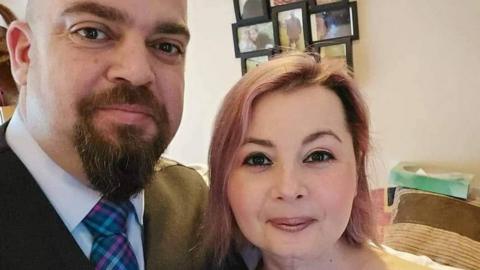
Laura now feels good six years after her diagnosis of advanced tongue cancer

Hundreds of thousands of people with advanced head and neck cancer could live longer without their cancer returning thanks to an immunotherapy drug, a clinical trial suggests.

This is the first sign of a breakthrough for patients with this difficult-to-treat cancer for 20 years, say scientists behind the research.

Laura Marston, 45, from Derbyshire, says she is "amazed she's still here" after being given "dire" chances of survival following a diagnosis of advanced tongue cancer six years ago.

She received the immunotherapy before and after surgery, which researchers say helps the body learn to attack the cancer if it returns.

Six years on, Laura is working full-time and says she's "in a good place and doing really well".

"It's been phenomenal for me, because I'm here, able to talk to you.

"I wasn't expected to come this far," Laura says.

"My prognosis was quite dire."

She had muscle taken from her left arm and placed into her mouth to fill the void left by her tongue. It has been a tough journey.

"Just having this amazing immunotherapy has given me my life back again."

The researchers say the key to their results was giving patients the drug before surgery, which trains the body to hunt down and kill the cancer if it ever comes back.

Prof Harrington says immunotherapy "could change the world" for these patients.

"It significantly decreases the chance of cancer spreading around the body, at which point it's incredibly difficult to treat," he said.

About 12,800 new head and neck cancer cases are diagnosed in the UK every year.

The approach worked "particularly well" for some patients, but it was "really exciting" to see the treatment benefitting all the patients in the trial, Prof Harrington said. He added that it should now be made available on the NHS, .

The study findings are being presented at the American Society of Clinical Oncology (ASCO) annual meeting.

The trial, called Keynote, involved 192 hospitals in 24 countries, was led by Washington University Medical School in St Louis and funded by drug company MSD.