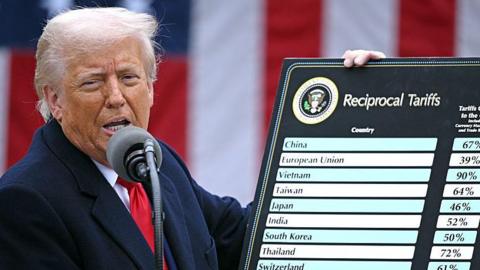
In essence, the powers he has asserted to "regulate importation" are narrow in scope and do not stretch to unlimited imposition of tariffs, in particular, to remedy trade deficits.
Of course, the Trump administration rather undermined their own logic by also levying "reciprocal" tariffs on countries with which it ran a trade surplus, such as the UK.
Separately the court also found that the president's basis for the fentanyl tariffs against Mexico, Canada, and China did not "deal with" their stated objective.
Trump's claim that they "create leverage" to do deals is not a permissible rationale for use of the powers. This dismantles the entire notion of the "art of the deal" 4D chess manoeuvres designed to extract trade advantages.
This will now be dealt with by the Supreme Court. The case appears rather robust, and also emboldens California's similar case.
It also totally undermines any attempt by the US Treasury Secretary Scott Bessent to negotiate deals with other countries.
The likes of Japan and the European Union were already holding back, after seeing the White House retreat in the face of tariff-related turbulence in US government borrowing rates.
US retailers were warning not just of tariff-related inflation, but of potential empty shelves. The row back on the China tariffs, purportedly fentanyl-trafficking enemy, means that actual G7 allies expect better treatment from the US.
And now its own courts deem the actions illegal. The White House is currently hemmed in by its own bond markets, retailers, big business, many individual states and now its courts on this policy.
While it hit back with an immediate appeal, some in the wider administration might well be privately toasting the judges.