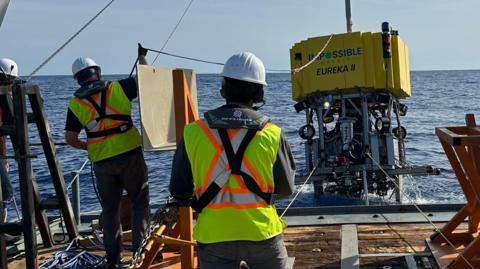
There's one. And another. This robot was hunting for rocks. A three-pronged claw descended from above and plucked a stone off the seabed.
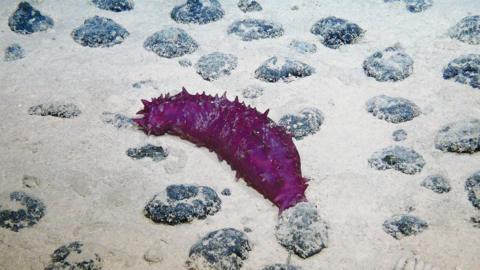
All the while, the autonomous machine's on-board camera scanned for creatures that might be resting on those rocks, to avoid snatching an innocent lifeform from its habitat.
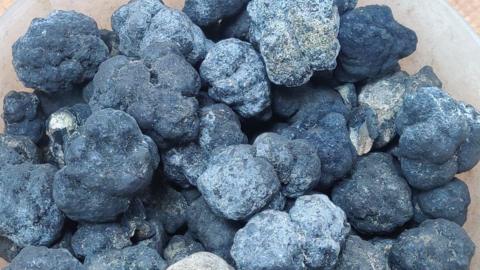
The test, carried out in a harbour in November, demonstrated one approach to mining for polymetallic nodules, potato-sized lumps containing metals scattered on the seabed in vast quantities, in much deeper parts of the ocean.
Such metals are sought-after for use in renewable energy devices and batteries, for example. But deep-sea mining is a controversial means of obtaining them because of its potentially significant environmental impacts.
"We felt that a vehicle that used AI to look for life and avoid it could have much less of an environmental footprint," explains Oliver Gunasekara, co-founder and chief executive of Impossible Metals.
The firm's system is 95% accurate at detecting lifeforms of 1mm or greater in size, he says.
The robot's arms are similar to those that pick and place items in automated warehouses – they are optimised for speed. Plus, each claw kicks up a relatively small puff of sediment as it plucks its target off the seafloor. Impossible Metals aims to further reduce this disturbance.