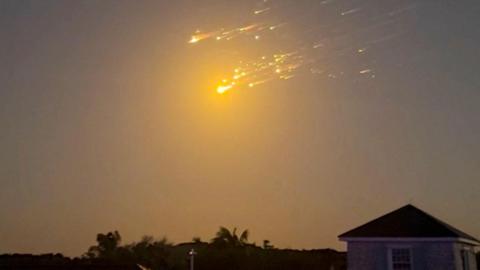
The accident briefly halted flights at several Florida airports, including in Miami and Orlando, over concerns about flaming debris.
A statement from the Federal Aviation Administration (FAA) said the flights in and out of airports were delayed due to a "space launch incident".
The incident follows a test in January, which saw a Starship rocket fail minutes after launching from SpaceX's Texas facility.
The FAA also briefly closed airports two months ago, due to the same concerns about falling debris.
After January's incident, the FAA grounded Starship launches and noted the incident had led to property damage in the Turks and Caicos Islands in the Caribbean.
"Unfortunately this happened last time too, so we have some practice at this now," SpaceX flight commentator Dan Huot told reporters at the launch site on Thursday.
This latest Starship launch was conducted before the FAA finished investigating January's explosion, according to US media reports.
A statement issued from the government of the Turks and Caicos said they were in contact with US authorities and SpaceX and would "continue to keep the public apprised as we work to ensure the safety and security of our Islands".
Footage posted on X purported to show flaming rocket debris falling over the Caribbean Sea. In the Bahamas, people posted that they were seeking shelter in order to take cover from debris.
Starship is the biggest, most powerful rocket ever built, and is key to Musk's ambitions for colonising Mars.
SpaceX's Starship spacecraft and Super Heavy rocket - collectively referred to as Starship - is intended to be fully reusable, the company says.
Nasa hopes to use a modified version of the spaceship as a human lunar lander for its Artemis missions to return to the Moon.
In the more distant future, Musk wants Starship to make long-haul trips to Mars and back - about a nine-month trip each way.