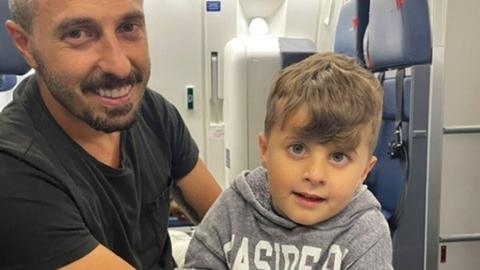
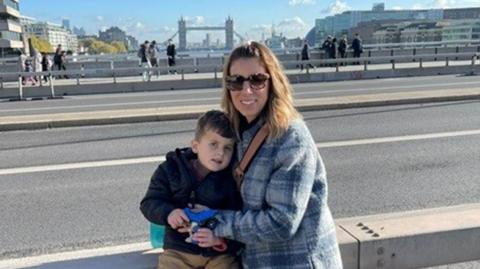
Jace, from Connecticut in the United States, had the gene therapy in London when he was just two years old.
As a young baby, his parents noticed something wasn't right about his eyesight.
"Around eight weeks old when babies should start looking at you and smiling, Jace wasn't doing that yet," says his mum DJ.
She knew instinctively there was an issue and began to search for the reason, which took 10 months.
After several visits to doctors and many tests, the family were told Jace had the ultra rare condition. It's caused by a mutation to a gene called AIPL1 and there is no established treatment.
"It was a shock," Jace's dad Brendan says of his first child.
"You never think it's going to happen to you, of course, but there was a lot of comfort and relief to finally find out... because it gave us a way to move forward."
The family was lucky to hear about an experimental trial being carried out in London - just by chance - when they were at a conference about the eye condition.
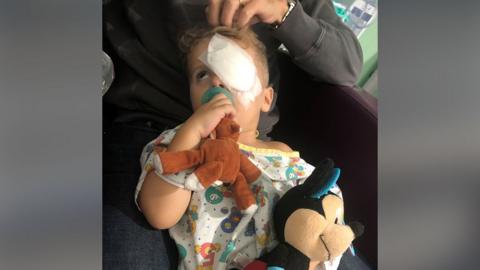
Jace's surgery was quick and "pretty easy", his mum says. He had four tiny scars in his eye where healthy copies of the gene were injected into the retina at the back of the eye through keyhole surgery.
These copies are contained inside a harmless virus, which goes through the retinal cells and replaces the defective gene. The healthy, working genes then kick start a process which helps the cells at the back of the eye work better and survive longer.
In the first month following treatment, Brendan noticed Jace squint for the first time on seeing bright sunshine streaming through the windows of their house.
His son's progress has been "pretty amazing", he says.
"Pre-surgery, we could have held up an object near his face and he wouldn't be able to track it at all.
"Now he's picking things off the floor, he's hauling out toys, doing things driven by his sight that he wouldn't have done before."
This may not be the last treatment he needs in his life, his parents say, but the improvements so far are helping him to know the world better.
"It's really hard to undersell the impact of having a little bit of vision," Brendan says.