Wubi News

Powerful quantum computers in years not decades, says Microsoft

2025-02-20 01:00:14

Jensen Huang - boss of the leading chip firm, Nvidia - said in January he believed "very useful" quantum computing would come in 20 years.

Chetan Nayak, a technical fellow of quantum hardware at Microsoft, said he believed the developments would shake up conventional thinking about the future of quantum computers.

"Many people have said that quantum computing, that is to say useful quantum computers, are decades away," he said. "I think that this brings us into years rather than decades."

Travis Humble, director of the Quantum Science Center of Oak Ridge National Laboratory in the US, said he agreed Microsoft would now be able to deliver prototypes faster - but warned there remained work to do.

"The long term goals for solving industrial applications on quantum computers will require scaling up these prototypes even further," he said.

Quantum computing holds the promise of carrying out calculations that would take today's systems millions of years and could unlock discoveries in medicine, chemistry and many other fields.

There are numerous important problems that "classical" computers, of the sort we use every day in our phones, and laptops and power most modern applications, cannot solve.

But these are problems quantum machines might be able to rapidly crack, promising new discoveries by creating new medicines or designing better batteries.

A host of technology firms, including the silicon valley giants, are currently engaged in a multi-billion dollar race to develop a quantum computer powerful enough to solve these problems.

Microsoft is approaching the problem differently to most of its rivals.

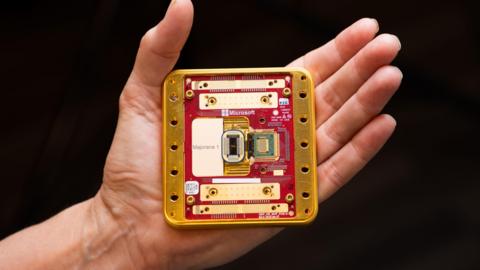
Its path to building a quantum computer relied upon being able to create a "topoconductor" or topological conductor.

It uses the newly developed material to create a new state of matter- a so-called "topological state" which isn't a gas, liquid or solid and, until relatively recently, had existed only in theory.

Specifically, it relies on so-called Majorana particles, which themselves were previously considered theoretical - work claiming that they had been discovered in 2018 had to be retracted.