Wubi News

'I have to shower at the gym' - disabled people wait for simple home changes

2025-02-12 21:00:06

Sam, a private renter in London, says she has never seen a fully accessible property available during online searches.

The three flats she has rented have all had showers over baths. But when her condition is at its worst, her legs are too stiff to lift over the side.

"I feel very anxious about slipping," says Sam, who has previously sustained injuries from falls.

If she cannot climb into the bath, but can manage the walk, Sam showers at her local gym. She says she has made the journey just to shower 150 times in four years.

"It has a really negative impact on your self-image and your time," she says.

It is more than four years since she says she first applied for help, while in her first rental. Councils should carry out a "person-centred" assessment to identify whether individuals qualify. Landlords cannot refuse an adaptation without good reason.

Without the adaptations, Sam worries her debilitative condition will become worse, more quickly. This would make staying in work increasingly difficult.

There is a push by the government to get disabled people into employment, she says, but it feels like "no-one's there to help" reduce the barriers.

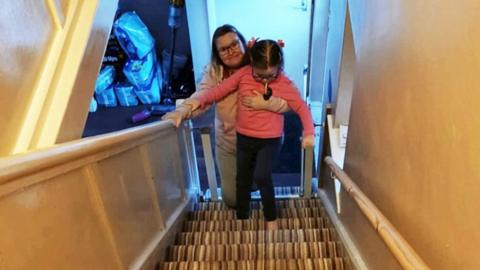
Claire and Emilia's home needs an extension to provide a downstairs bedroom and shower room

In Staffordshire, seven-year-old Emilia has a rare genetic condition called PTEN hamartoma tumour syndrome. She has a learning disability, hypermobility, is doubly incontinent, and is more susceptible to cancers.

If she climbed the stairs alone, to reach the bathroom or her bedroom, she would fall.

Her mum Claire has damage to her spine, yet has to prop her daughter up with every step - risking paralysis if she bears too much weight.

"I'm always frightened [if my back gives way] that we're going to end down at the bottom of the stairs," she says.

Claire's spinal injury means she isn't able to help Emilia into a stairlift and so, in July 2022, the family - who are Housing Association tenants - were assessed as requiring an extension for a downstairs bedroom and shower room.

Building work is due to begin at Claire and Emilia's home

"Months and months went by when nobody [at the council] would answer the phone," says Claire.

The maximum amount councils can provide under the Disabled Facilities Grant in England, set by government, is £30,000. This is means-tested for adults, but not for children, and is currently under review.

In Claire and Emilia's case, the estimated cost of the extension is £60,000, which they believe caused the delays. "It's all about money," she says.

If councils have enough money in their home adaptations budget they can choose to provide extra funding, but not all do. Social services can provide financial assistance too.

Two-and-a-half years on, building work is set to begin soon.

Newcastle-under-Lyme Borough Council said this was a "complex case" and that it had needed to "resolve additional funding and get the necessary permissions to extend the property".

It says it is working to reduce delays. Other councils are taking steps too.

In Gloucestershire, NHS occupational therapist Neil Withnell is working with six local authorities to speed up cases - training additional staff for assessments and providing extra funding for people on lower incomes.

Adaptations, he says, can be "life-changing".