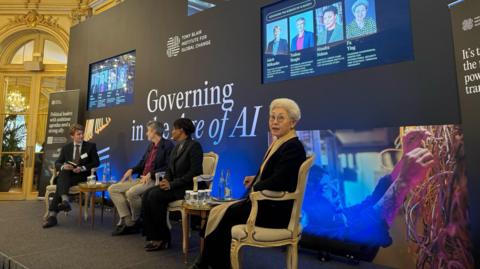
The pair's heated exchanges were a symbol of global political jostling in the powerful AI arms race, but Fu Ying also expressed regret about the negative impact of current hostilities between the US and China on the progress of AI safety.
"At a time when the science is going in an upward trajectory, the relationship is falling in the wrong direction and it is affecting unity and collaboration to manage risks," she said.
"It's very unfortunate."
She gave a carefully-crafted glimpse behind the curtain of China's AI scene, describing an "explosive period" of innovation since the country first published its AI development plan in 2017, five years before ChatGPT became a viral sensation in the west.
She added that "when the pace [of development] is rapid, risky stuff occurs" but did not elaborate on what might have taken place.
"The Chinese move faster [than the west] but it's full of problems," she said.
Fu Ying argued that building AI tools on foundations which are open source, meaning everyone can see how they work and therefore contribute to improving them, was the most effective way to make sure the tech did not cause harm.
Most of the US tech giants do not share the tech which drives their products.