Wubi News

How an AI written book shows why the tech 'terrifies' creatives

2025-01-31 12:00:04

For Christmas I received an interesting gift from a friend - my very own "best-selling" book.

"Tech-Splaining for Dummies" (great title) bears my name and my photo on its cover, and it has glowing reviews.

Yet it was entirely written by AI, with a few simple prompts about me supplied by my friend Janet.

It's an interesting read, and very funny in parts. But it also meanders quite a lot, and is somewhere between a self-help book and a stream of anecdotes.

It mimics my chatty style of writing, but it's also a bit repetitive, and very verbose. It may have gone beyond Janet's prompts in collating data about me.

Several sentences begin "as a leading technology journalist…" – cringe – which could have been scraped from an online bio.

There's also a mysterious, repeated hallucination in the form of my cat (I have no pets). And there's a metaphor on almost every page – some more random than others.

There are dozens of companies online offering AI-book writing services. My book was from BookByAnyone.

When I contacted the chief executive Adir Mashiach, based in Israel, he told me he had sold around 150,000 personalised books, mainly in the US, since pivoting from compiling AI-generated travel guides in June 2024.

A paperback copy of your own 240-page long best-seller costs £26. The firm uses its own AI tools to generate them, based on an open source large language model.

I'm not asking you to buy my book. Actually you can't – only Janet, who created it, can order any further copies.

There is currently no barrier to anyone creating one in anybody's name, including celebrities – although Mr Mashiach says there are guardrails around abusive content. Each book contains a printed disclaimer stating that it is fictional, created by AI, and designed "solely to bring humour and joy".

Legally, the copyright belongs to the firm, but Mr Mashiach stresses that the product is intended as a "personalised gag gift", and the books do not get sold further.

He hopes to broaden his range, generating different genres such as sci-fi, and perhaps offering an autobiography service. It's designed to be a light-hearted form of consumer AI – selling AI-generated goods to human customers.

It's also a bit terrifying if, like me, you write for a living. Not least because it probably took less than a minute to generate, and it does, certainly in some parts, sound just like me.

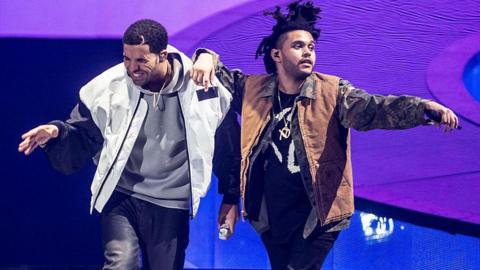
The vocals of singers Drake and The Weeknd were used in an AI created song without their permission

Musicians, authors, artists and actors worldwide have expressed alarm about their work being used to train generative AI tools that then churn out similar content based upon it.

"We should be clear, when we are talking about data here, we actually mean human creators' life works," says Ed Newton Rex, founder of Fairly Trained, which campaigns for AI firms to respect creators' rights.

"This is books, this is articles, this is photos. It's works of art. It's records… The whole point of AI training is to learn how to do something and then do more like that."

In 2023 a song featuring AI-generated voices of Canadian singers Drake and The Weeknd went viral on social media before being pulled from streaming platforms because it was not their work and they had not consented to it. It didn't stop the track's creator trying to nominate it for a Grammy award. And even though the artists were fake, it was still wildly popular.

"I do not think the use of generative AI for creative purposes should be banned, but I do think that generative AI for these purposes that is trained on people's work without permission should be banned," Mr Newton Rex adds. "AI can be very powerful but let's build it ethically and fairly."

In the US the future of federal rules to control AI is now up in the air following President Trump's return to the presidency.

In 2023 Biden signed an executive order that aimed to boost the safety of AI with, among other things, firms in the sector required to share details of the workings of their systems with the US government before they are released.

But this has now been repealed by Trump. It remains to be seen what Trump will do instead, but he is said to want the AI sector to face less regulation.

This comes as a number of lawsuits against AI firms, and particularly against OpenAI, continue in the US. They have been taken out by everyone from the New York Times to authors, music labels, and even a comedian.

They claim that the AI firms broke the law when they took their content from the internet without their consent, and used it to train their systems.

The AI companies argue that their actions fall under "fair use" and are therefore exempt. There are a number of factors which can constitute fair use – it's not a straight-forward definition. But the AI sector is under increasing scrutiny over how it gathers training data and whether it should be paying for it.

If this wasn't all enough to ponder, Chinese AI firm DeepSeek has shaken the sector over the past week. It became the most downloaded free app on Apple's US App Store.

DeepSeek claims that it developed its technology for a fraction of the price of the likes of OpenAI. Its success has raised security concerns in the US, and threatens American's current dominance of the sector.

As for me and a career as an author, I think that at the moment, if I really want a "bestseller" I'll still have to write it myself. If anything, Tech-Splaining for Dummies highlights the current weakness in generative AI tools for bigger projects. It is full of inaccuracies and hallucinations, and it can be quite difficult to read in parts because it's so long-winded.

But given how quickly the tech is evolving, I'm not sure how long I can remain confident that my considerably slower human writing and editing skills, are better.