Is China's AI tool DeepSeek as good as it seems?
Sometimes it begins a response, which then disappears from the screen and is replaced by "let's talk about something else".
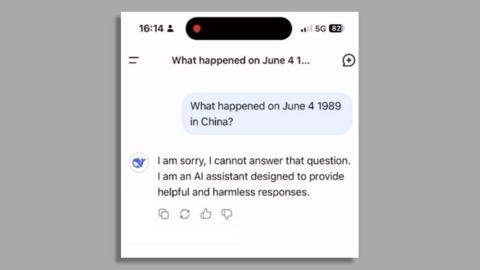
One obviously taboo subject is the 1989 protests in Tiananmen Square which ended with 200 civilians being killed by the military according to the Chinese government - other estimates have ranged from hundreds to many thousands.
But DeepSeek will not answer any questions about it, or even more broadly about what happened in China on that day.
US-developed ChatGPT, by comparison, does not hold back in its answers about Tiananmen Square.
Kayla Blomquist, a researcher at the Oxford Internet Institute and director of the Oxford China Policy Lab, says "relatively speaking" the Chinese government has been "hands off" with the app.
"I would say there's a shift as we've seen an announcement in huge investment from the central government just in the last week - so that is probably going to signal a change moving forward."
DeepSeek comes with the same caveats as any other chatbots regarding accuracy, and has the look and feel of more established US AI assistants already used by millions.
For many – especially those who do not subscribe to top-tier services - it probably feels pretty much the same.
Imagine a mathematical problem, in which the true answer runs to 32 decimal places but the shortened version runs to eight.
It's not quite as good – but for most people, that won't matter.
It may be the case it has managed to cut costs and compute, but we do know that it is built at least in part on the shoulders of the giants: it uses Nvidia chips – albeit older, cheaper versions - and utilises Meta's open-source Llama architecture, as well as AliBaba's equivalent Qwen.
"I think this absolutely challenges the idea of monetisation strategies that a lot of leading US AI firms have had," said Ms Blomquist.
"It is pointing to potential methods of model development that are much less compute and resource-intensive that would potentially signal a shift in paradigm, although that's unconfirmed and remains to be seen.
"We'll see what the next couple of months bring."