Wubi News

30 years ago Tomorrow's World predicted 2025 - how did it do?

2025-01-01 11:00:17

In 1995, the world wide web was really taking off - a development Tomorrow's World thought would bring future trouble.

They predicted "business barons" and banks would take control of the internet by 2000, establishing a "supernet" which they restricted access to.

That, in turn, would prompt hacks, viruses and even riots.

The programme speculated space mining would become a lucrative industry, with companies excavating asteroids near Earth for precious metals.

The show also suggested space junk would become such a problem it would not be safe for astronauts. The answer - a gigantic foam gel to slow down debris.

Verdict - Well, there is no super foam gel and the problem of space junk is an acute one. There is also no space mining industry - but that could change.

Futurist Tom Cheesewright is an optimist about mining beyond our planet.

"The potential riches are unfathomable and the technology is entirely within our grasp," he said.

Tomorrow's World predicted by 2004, a law would be passed for all UK hospitals to publish a league table of surgeon success rates. The top surgeons would become so popular, and so well paid, it would make no sense for them to travel to patients.

Instead, patient holograms would be sent to them and the surgeon would operate using "spacial gloves". At the patient's end, a robot would perfectly mimic the movements of the surgeon.

Verdict - They didn't get it exactly right but robots are helping with surgeries.

The programme featured a man of the future (wearing a fetching VR headset), his wife and a young girl in what appears to be modern-day London.

In one section, the floating head of a woman comes out of a "smart speaker" to tell the man it has been a year since his holiday to "Indo Disney." She encourages him to take another holiday via a "shuttle to Bangalore" - which would only take 40 minutes.

Verdict - Ultra-fast travel feels as far away as ever, but holograms, smart speakers and VR headsets are becoming ever more prevalent.

Elsewhere in the programme, we were given a vision of the future of banking.

It featured a woman going to a bank, complaining there were no humans, and then withdrawing 100 "Euro marks." The bank gives her the money after scanning a chip in her arm.

Verdict - Banking has indeed become more and more automated. And though paying via microchips inside the human body is a reality, other technologies - mainly fingerprint and face scanning - are much more widely used.

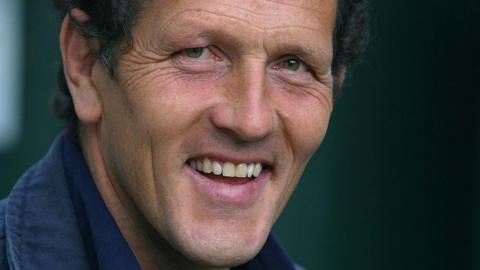
Monty Don is a familiar face to many who enjoy gardening programmes

Vivienne Parry was another presenter on the prediction show, and fronted a section about medicine.

She fondly remembers filming it - and the rather limited visual effects of the day. "I had to stay absolutely still. I had a set of glasses on with a little camera attached. They were stuck on my face via a big blob of black sticky stuff.

"It was this fantastically hot day, and this black stuff started to leak down my face and I couldn't move. Someone from make-up came along with a long cane with cotton wool on the end to get it off."

Vivienne has been involved with Genomics England since 2013, and highlights that some of the predictions from the 1995 Tomorrow's World about genomic sequencing have come true, as she works on a research study to help diagnose and treat genetic conditions.

Futurist Tracey Follows thought the 1995 programme got a lot of big ideas right, but missed two of the biggest themes of the last 30 years - the spread of big tech and social media.

By 2055, she thinks many people will be "cognitively connected" - a hive mind of humans and technology via servers, which will help in the sharing of ideas.

"Brainstorming will literally be brainstorming, where you can share ideas by thinking them."

Tom Cheesewright thinks two of the most exciting prospects for the next 30 years will be materials science and bioengineering.

In materials, the creation of devices that are even stronger, lighter and thinner could change the world, while bioengineering - married with tight regulation - has the power to transform medicine and tackle "some of the biggest challenges humanity faces - decarbonisation, clean water, food".

So what do you think the world will look like in 30 years?

Whatever your answers, it would be wise to listen to what Prof Hawking said to Tomorrow's World three decades ago.

"Some of these changes are very exciting, and some are alarming. The one thing that we can be sure of is that it will be very different, and probably not what we expect."