Wubi News

'A brain tumour the size of a tennis ball came out my eyebrow'

2024-10-25 11:00:09

Pioneering surgery to remove large brain tumours through the eyebrows of patients has been successfully carried out in Scotland.

In what has been described as a "world first", NHS Grampian said tumours the size of large apples have been removed using the technique.

Consultant neurosurgeon Anastasios Giamouriadis has adapted the already-existing eyebrow technique to enable him to now remove larger growths - a development which he described as a "game-changer".

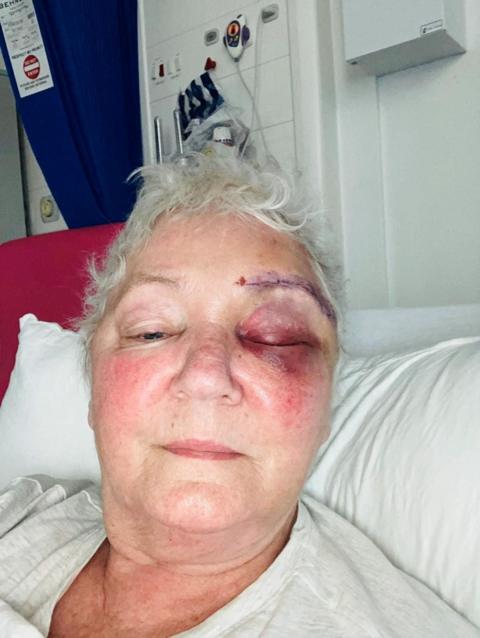
The surgery is said to have fewer complications, a shorter operating and recovery time, and less scarring as a result. One recipient - who described her tumour as like a tennis ball - said she was out of hospital in just two days with nothing but a black eye.
Traditional surgery for patients with tumours at the front of their brain involves having to remove a large part of the skull, in what is known as a craniotomy.

It is a lengthy, complex process, which can take up to 10 hours, and exposes healthy parts of the brain during the operation.

Known as the Modified Eyebrow Keyhole SupraOrbital Approach for Brain Tumours, the new technique means patients are expected to be left with only a small scar and a black eye.

Some are able to leave hospital just 24 hours later and return to work within days.

Doreen Adams had her operation via an eyebrow

She explained: "My recovery from the surgery at Aberdeen Royal Infirmary was much, much quicker.

"I was out of hospital two days later and back to my normal life almost immediately.

“I was out in two days with nothing apart from a black eye.

"To think you can have brain surgery and be back to normal within a few days is quite incredible.

"I’m very grateful to Mr Giamouriadis and NHS Grampian – it’s fantastic that we have this innovative approach and these skills here in the north east.”

He said the operation can be over in as little as three hours.

“Traditionally people would be left with scars across their full forehead, we avoid that with this method," he explained.

"Normally our patients will go home on the second day with a bruised eye, as expected, which will return back to normal within a few days.

“It makes a huge impact for the patient, for their families, for the society, for the organisation, for the NHS.

“It’s a game-changer."