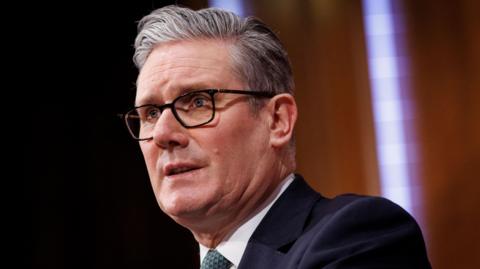
Listening to the prime minister's tone and language this morning, the gravity of this moment was abundantly apparent.
Sir Keir Starmer isn't a man to shoot his mouth off in public. He tends to pick his words carefully and avoid exaggeration or hyperbole.
That is exactly what he did today, but with a clear subtext: the events of the last 48 hours or so had crossed a rubicon. Downing Street's long running attempts to avoid, wherever possible, public disagreements with the White House had run their course.
To be clear, it is not the first time there has been a disagreement. During President Trump's state visit to the UK last autumn, I asked the two leaders about another issue where they transparently disagreed – the UK's decision to recognise a Palestinian state.
But President Trump's plan to impose tariffs – economic sanctions – on European allies not willing to acquiesce to his plan to take over Greenland is clearly a different category of disagreement: one the prime minister sought to ground in what he saw as the inviolable principles the UK has long regarded as sacrosanct – respecting the sovereign rights of other countries to determine their own futures.