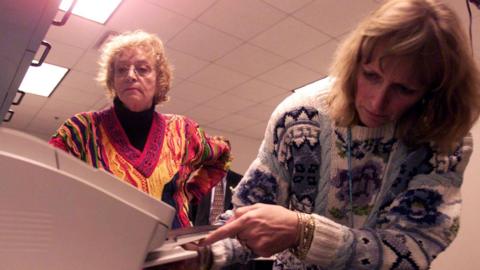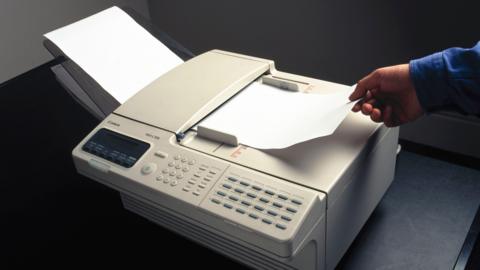
One hundred and eighty years after the first fax machines started grinding out messages, three NHS trusts in England are still using the technology.
Health Secretary Wes Streeting had made it his personal mission to banish the fax, pledging to Radio 5 Live in October 2024 that he would phase them out of the health service within a year.
Now he has returned with an update - and it is not quite mission accomplished.
"I'm happy to report that having gone away and scoured the NHS for evidence of fax machines being put to use, of the 205 NHS trusts we have in the country, only three are now using fax machines for everyday use, which are Leeds, Birmingham and Shrewsbury and Telford," Streeting said.
"Now, in the case of Leeds and Birmingham, they have a plan to phase them out entirely in the next 12 months.
"Shrewsbury and Telford's going to take them a bit longer."
Streeting told me he was now working with the three institutions - Leeds Teaching Hospitals NHS Trust, University Hospitals Birmingham NHS Foundation Trust and Shrewsbury and Telford Hospital NHS Trust - to move into the 20th century, if not the 21st.
But he added: "I decided that having been told by these trusts that were I to politically order them to cease use I would cause them some quite significant operational headaches, I decided to do the right thing and explain to you that there are still three trusts using fax machines."
Fax machines - formally known as facsimile machines - used to be a familiar fixture in offices as well as schools, hospitals and police stations across the country.
They worked by allowing users to feed a page of text or images into a machine, which would be sent over a telephone line and printed out for the recipient.
The technology was overtaken by email in the early 2000s, but persisted in some offices, particularly in the health service.
Back in December 2018, Conservative health secretary Matt Hancock banned the NHS from buying new faxes and ordered a complete phase-out by April 2020.