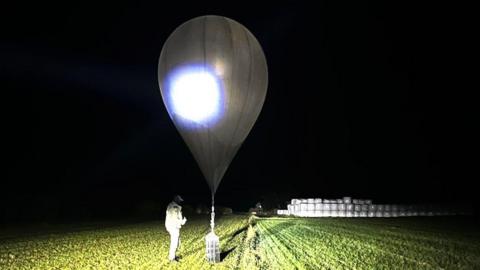
Lithuania has accused Belarus of this kind of provocation before. Four years ago, thousands of irregular migrants mostly from the Middle East crossed the Belarusian border.
Responding to the latest threat, Lithuania closed two border checkpoints with Belarus for three weeks from the end of October. Belarus then barred Lithuanian trucks from driving on its roads and hundreds of Lithuanian vehicles are still understood to be stranded there.
"We are talking about aviation security and international law, and about the fact that such actions could be recognised as terrorism," Ruginiene said last week, in reference to both the balloons and the blocked trucks.
The weather balloons can fly to a height of 10km (6 miles) and Lithuania's interior ministry says they have led to Vilnius airport being closed for more than 60 hours since October. Some 30,000 passenger were affected in October alone.
Lukashenko told Belarusian TV on Tuesday that what the Lithuanians were accusing Belarus of was impossible: "It is unrealistic. Even if balloons flew into there, even if they did, I have spoken to pilots and they say that they pose no problem."
"The question arises why," he added. "Do they want to fight us? We do not need war. I am convinced that the Lithuanian people do not need war either. Neither do Poles, Latvians and Estonians."
Although flights into and out of Vilnius airport were disrupted for only a short period on Saturday night, it meant that 1,000 passengers were affected. Authorities said they had intercepted 11 smuggling balloons and seized almost 40,000 packets of cigarettes.
On one night last week, the airport had to suspend operations three times and Finnish airline Finnair has cancelled all evening flights to Vilnius until the end of February because of the balloons.