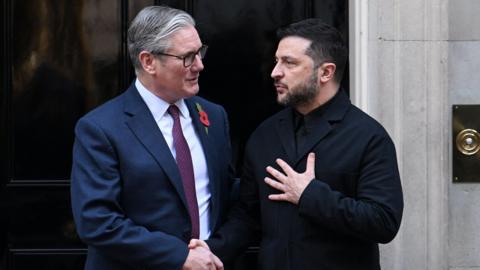
Monday's talks in London will feature Starmer, French President Emmanuel Macron and German Chancellor Friedrich Merz, who represent the three Nato nations with the largest military budgets in real terms, with the exception of the US.
Downing Street said the meeting would "focus on the ongoing peace negotiations and next steps", while UK cabinet minister Pat McFadden said it would explore ways to ensure Ukraine is "able to decide its own future".
He said there needed to be meaningful security guarantees in the event of a peace deal, not a "toothless organisation".
The UK and France have led talks to assemble a so-called coalition of the willing - also referred to as the Multinational Force Ukraine - in order to offer future defence support, including a possible reassurance force deployed in the country.
It is not yet clear what functions it would perform, though diplomatic sources have previously indicated it would not be used to police a ceasefire line, and would differ to a peacekeeping force in the sense that it would not be classed as impartial.
Germany and other European defence players, including Italy and Poland, have pledged forms of defence assistance, but have expressed scepticism about the prospect of putting troops on the ground inside Ukraine - a proposal the Kremlin has said it would consider an escalation.
The White House has been pushing Kyiv and Moscow to swiftly agree to a multi-point plan to end the war.
But there has been little sign of a breakthrough, including after Witkoff held five hours of in-person talks with Russian President Vladimir Putin in Moscow last week.
As well as security guarantees, negotiations remain particularly fraught around the issue of territorial concessions.
The US has proposed Ukraine pulls its forces entirely out of eastern regions which Russia has attempted to take by force but has been unable to capture in full, in return for Russian withdrawals elsewhere and a cessation of fighting.
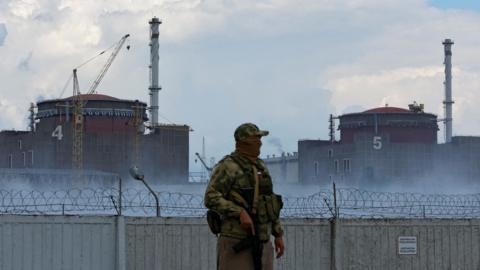
Speaking on Sunday, Trump's outgoing special envoy for Ukraine Keith Kellogg also singled out talks around the Zaporizhzhia nuclear power plant as being particularly complex.
Intense fighting has raged at times around the facility, which is the largest in Europe and currently under Russian control. A leaked early draft of the US-backed peace plan proposed splitting the energy it generates in the future between Ukraine and Russia.
Kellogg told an event in California that a deal was close but talks on those elements were continuing, adding: "If we get those two issues settled, I think the rest of the things will work out fairly well."