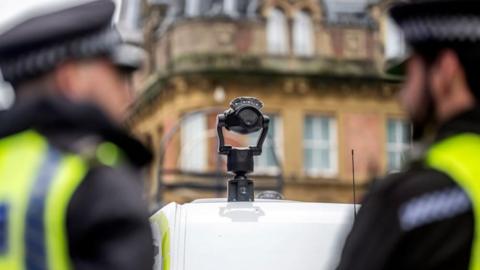
There are currently three different types of facial recognition technology available to police:
According to the Home Office, the Metropolitan Police has made 1,300 arrests using the technology since 2023, including rapists and violent offenders.
The government invested £12.6m in facial recognition in 2024, of which £2.8m was spent on live recognition.
A further £6.6m has been invested this year supporting the adoption, evaluation, and roll-out of facial recognition technology. This includes £3.9m for the development of a new, national facial matching service. A test of this will be rolled out sometime in 2026.
It aims to give police a new way to carry out retrospective searching and have another national database of custody images.
The new database, which would be run by the Home Office, could hold millions of images, similar to the numbers on the police national database.
The facial matching service is also being trialled separately to help identify and find people being sought by immigration enforcement.
The Home Office believes facial recognition technology could also help to identify and arrest prisoners released by mistake, and would only be used in time-limited, focused deployments.
"Facial recognition is the biggest breakthrough for catching criminals since DNA matching," Jones said.
"We will expand its use so that forces can put more criminals behind bars and tackle crime in their communities."