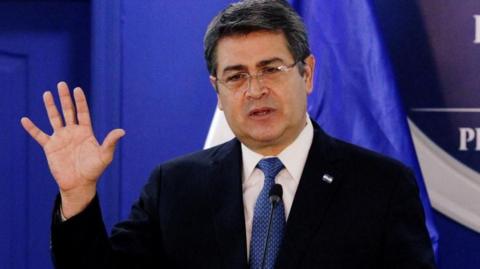
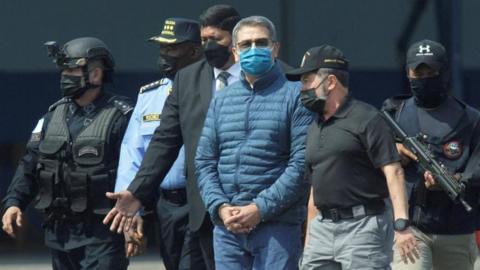
Trump announced the pardon on Friday in a Truth Social post, writing that, according to "many people that I greatly respect", Hernández had been unfairly treated by prosecutors.
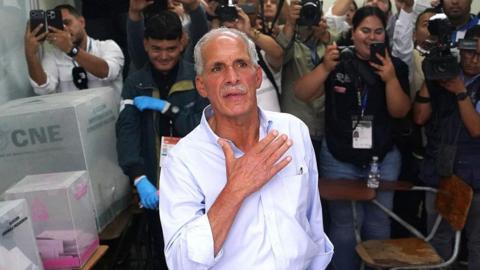
In the same post, he also endorsed Tito Asfura for president of Honduras ahead of Sunday's election. Asfura ran under the same National Party ticket as Hernández.
As of Tuesday, preliminary results show the election is too close to call, forcing a hand recount of ballots.
Trump's endorsement of Asfura wasn't surprising to many, given the right-leaning National Party's ideological alignment with the current US administration.
Trump has also weighed in on the politics of other countries in the Western Hemisphere, like Brazil and Argentina.
"We've seen the President's affinity with leaders on the right that he sees as being favourable to some of interests of his administration," noted Jason Marczak, vice-president and senior director at the Atlantic Council's Adrienne Arsht Latin America Center.
But the decision to pardon Hernández simultaneously stunned some experts.
"It was hard for me to believe, because there was such an overwhelming case against Hernández," said Michael Shifter, an adjunct professor at the Center for Latin American Studies at Georgetown University.
Mr Shifter added that what he found more puzzling was the "contradiction" between the pardon and Trump's declared policy of clamping down on drug trafficking.
Trump has repeatedly pledged to curb the flow of drugs into the US, and carried out highly controversial strikes on boats in the waters around Venezuela that his administration says are piloted by drug traffickers.
More than 80 people have been killed in a number of strikes in the Caribbean Sea since early September.