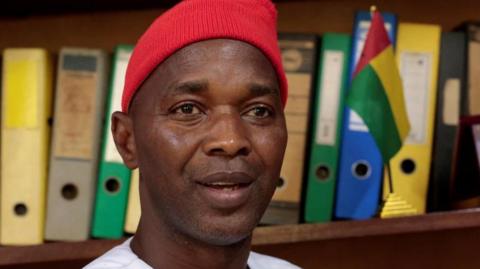
Dias said he escaped from his campaign headquarters on the day of the coup as armed men came to arrest him.
Nigeria's Foreign Minister Yusuf Tuggar said President Bola Tinubu had agreed to give Dias protection inside the Nigerian embassy in Bissau.
"The decision to accommodate Mr [Fernando Dias] da Costa in the Nigerian premises underscores our firm commitment to safeguarding the democratic aspirations and the sovereign will of the good people of Guinea-Bissau," Tuggar said in a letter to Ecowas Commission president Alieu Omar Touray.
The letter also asked that soldiers from an Ecowas unit in the country be deployed to the Nigerian embassy to keep Dias safe.
Meditation talks on Monday between the Ecowas delegation, led by Sierra Leone's Foreign Minister Alhaji Musa Timothy Kabba, and the junta were heated.
Afterwards, Kabba told journalists that the discussions were "productive," but noted that "both parties expressed their concerns".
The junta has already sworn in a new transitional leader, Gen Horta N'Tam, who will rule the country for a year.
Ecowas leaders have suspended Guinea-Bissau from all decision-making bodies until constitutional order is restored.
The true motives behind the coup in Guinea-Bissau remain unclear amid speculation that it may have been staged.
Senegal's Prime Minister Ousmane Sonko and Nigeria's ex-leader Goodluck Jonathan have both said the coup was fabricated without providing evidence.
Some local civil society groups have also accused Embaló of masterminding a "simulated coup" against himself with the help of the military, saying it was a ruse to block election results from coming out in case he lost.
Embaló, who has previously faced accusations of using crises to quash dissent, has not responded to the coup allegations.
The 53-year-old was allowed to leave for neighbouring Senegal on Thursday, from where he reportedly moved on to Congo-Brazzaville at the weekend.
Guinea-Bissau has witnessed at least nine coups or attempted coups over the last five decades.
Sandwiched between Senegal and Guinea, it is known as a drug-trafficking hub where the military has been influential since it gained independence from Portugal in 1974.