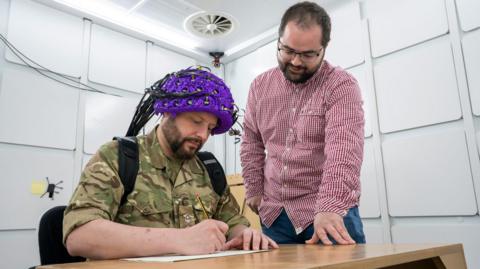
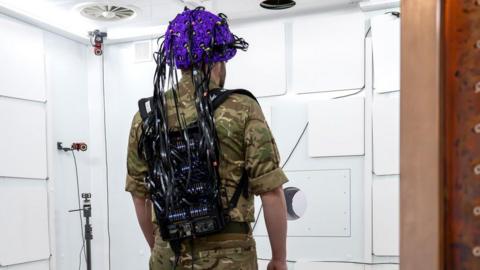
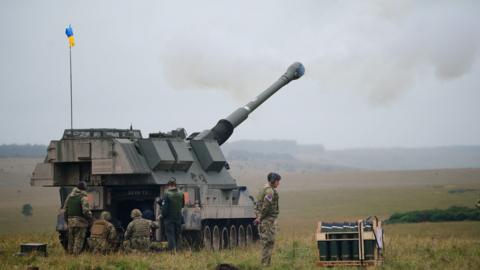
The study will focus on how brains are affected by shockwaves produced by personnel using weapons.
Prof Mullinger said: "We know there are differences in their behaviour within the first 24 hours after they come off the training range.
"But that disappears and if we can't monitor them quickly we might be missing any damage which has happened."
Such information, scientists said, addressed a "critical defence challenge", whether repeated exposure to shock waves from high-power weapons causes subtle changes in brain function.
This, over a career, might increase the likelihood of serious brain health conditions.
Prof Matthew Brookes, professor of physics at the University of Nottingham, said: "This new generation of MEG lifts limitations that have historically confined scanners to universities, paving the way for mobile systems that can be taken directly to those who will benefit most.
"The introduction of mobile systems will likely revolutionise other fields too, whether parked outside hospitals to assess neurological conditions or at sports grounds to scan players following concussion."
Lt Col James Mitchell, consultant neurologist and chief investigator of the UK Military Blast Study at the UK Defence Medical Services, said: "This new system, a world first, will be transformative for research into the effects of blast exposure on our personnel.
"For the first time we will be able to build a time-stamped, accurate picture of exactly what happens to the brain in the minutes and hours after blast exposure and track recovery over time.
"Ultimately, we expect this system to help provide robust, scientifically informed policy on safe working practices for blast exposure."
The system is expected to be operational by 31 March 2026.