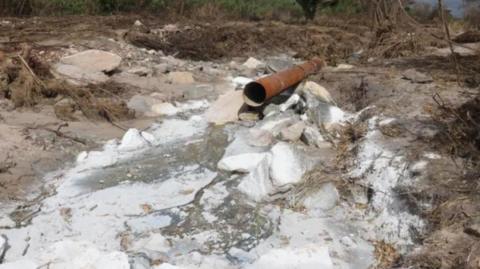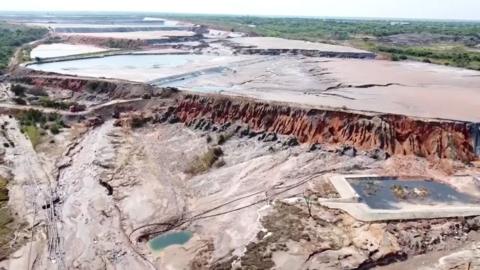
Lamec, like his country Zambia, finds himself in a difficult position. The mine is owned by Sino-Metals Leach Zambia, a subsidiary of a Chinese state-owned firm, which has created - according to Chinese sources - more than 2,000 jobs.
Chinese companies like these provide jobs and much needed revenue in Africa. Although the US has recently become the biggest foreign investor across the continent, China is still one of the largest investors in Africa's rich minerals and metals industry - not least in Zambia's Copperbelt Province, the scene of the dam collapse.
More than 30,000 jobs have been created by Chinese companies across Zambia, according to the Chinese embassy. Investment from China was estimated to be worth $1.7bn (£1.3bn) last year. And - in a sign of the close links between the two countries - Chinese Premier Li Qiang visited Zambia late last month, ahead of the G20 Leaders' Summit in South Africa.
But China has also been accused of neocolonialism, with critics arguing that its infrastructure loans trap African countries in unmanageable debt, that it doesn't upskill local workers, preferring to bring its own in instead, and that its focus on mineral extraction sometimes comes at the expense of safeguarding the environment.
In September, 176 farmers filed an $80bn (£58bn) lawsuit against Sino Metals and NFC Africa, the Chinese firm that owns the land the mine is on. It is one of the biggest environmental lawsuits in Zambia's history, with the farmers alleging the spillage has already affected 300,000 households.
They say the dam's collapse was caused by a number of factors, including engineering failures, construction flaws and operational mismanagement.