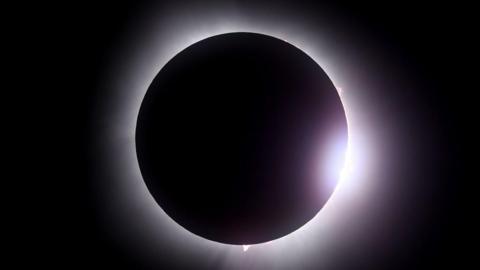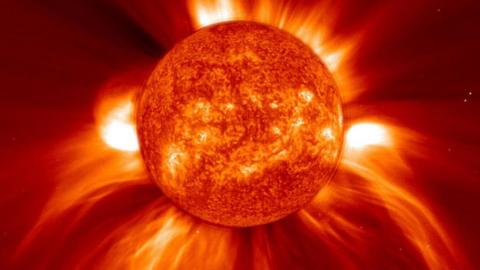
For Aditya-L1, India's first solar observation mission in space, the year 2026 is expected to be like no other.
It's the first time the observatory – which was placed in orbit last year - will be able to watch the Sun when it reaches its maximum activity cycle.
According to Nasa, it comes roughly every 11 years when the Sun's magnetic poles flip - the Earth equivalent would be the North and South poles swapping positions.
It's a time of great turbulence. It sees the Sun transition from calm to stormy and is marked by a huge increase in the number of solar storms and coronal mass ejections (CMEs) - massive bubbles of fire that blow out of the Sun's outermost layer called corona.
Made up of charged particles, a CME can weigh up to a trillion kilograms and can attain a speed of up to 3,000km (1,864 miles) per second. It can head out in any direction, including towards the Earth. At top speed, it would take a CME 15 hours to cover the 150 million km Earth-Sun distance.
"In the normal or low-activity times, the Sun launches two to three CMEs a day," says Prof R Ramesh of the Indian Institute of Astrophysics (IIA). "Next year, we expect them to be 10 or more daily."
Prof Ramesh is the principal investigator on Visible Emission Line Coronagraph, or Velc - the most important of the seven scientific instruments on Aditya-L1 - and closely monitors and decodes the data it gathers.
Studying CMEs is one of the most important scientific objectives of India's maiden solar mission, he says. One, because the ejections provide an opportunity to learn about the star at the centre of our solar system, and two, because activities that take place on the Sun threaten infrastructure on Earth and in space.