Wubi News

'I saw them driving over injured people' - the terrifying escape from war in Sudan

2025-12-01 07:00:02
The war in Sudan has displaced millions of people with some fleeing el-Fasher making it to al-Dabbah

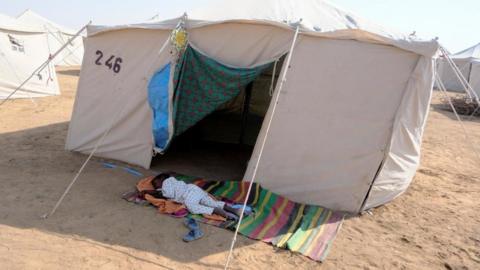
We found Mr Ali wandering around the camp, located in the desert about 770km (480 miles) north-east of el-Fasher, near the town of al-Dabbah.

He was trying to register his family for a tent.

"They [RSF fighters] were shooting at the people - the elderly, the civilians, with live ammunition, they would empty their guns on them," he told us.

"Some of the RSF came with their cars. If they saw someone was still breathing, they drove over them."

Mr Ali said he ran when he could, crawling along the ground or hiding when the threat got too close. He managed to get to the village of Gurni, a few kilometres from el-Fasher.

Gurni was the first stop for many who fled the city, including Mohammed Abbaker Adam, a local official in the nearby Zamzam camp for displaced people.

Mr Adam retreated to el-Fasher when Zamzam was overrun by the RSF in April, and left the day before they captured the city in October.

He grew a white beard to make himself look older, hoping that it would lead to more lenient treatment.
"The road here was full of death," he said.

"They shot some people directly in front of us and then carried them and threw them far away. And on the road, we saw dead bodies out in the open, unburied. Some had lain there for two or three days."

"So many people are scattered around," he added. "We don't know where they are."

Some of those who did not take the long trek to al-Dabbah made it to a humanitarian hub in Tawila, some 70km from el-Fasher.

Others crossed into Chad. But the UN says less than half of the 260,000 people estimated to have been in the city before it fell have been accounted for.

Aid agencies believe many people did not get very far - unable to escape because of danger, or detention, or the cost of buying their way out.

Mr Adam said the fighters also raped women, corroborating widespread accounts of sexual violence.

"They would take a woman behind a tree, or take her far from us, out of sight, so you wouldn't see with your own eyes," he said.

"But you would hear her shout: 'Help me, help me.' And she would come and say: 'They raped me.'"

There are mostly women in the camp, and many do not want to be identified to protect those left behind.

One 19-year-old woman told us that RSF fighters at a checkpoint took a girl from the group she was travelling with, and they had to leave her behind.

"I was scared," she said. "When they took her out of the car at the checkpoint, I was afraid that at every checkpoint they would take a girl. But they just took her, and that was it until we got here."

She had travelled here with her younger sister and brother. Her father, a soldier, had been killed in battle. Her mother was not in el-Fasher when it fell.

So the three siblings escaped the city on foot with their grandmother, but she died before they reached Gurni, leaving them to carry on alone.

"We hadn't taken enough water because we didn't know the distance was so far," said the young woman.

"We walked and walked and my grandmother passed out. I thought it might be lack of food or water.

"I checked her pulse, but she didn't wake up, so I found a doctor in a nearby village. He came and said: 'Your grandmother has given you her soul.' I was trying to keep myself together because of my sister and brother, but I didn't know how I would tell my mother."

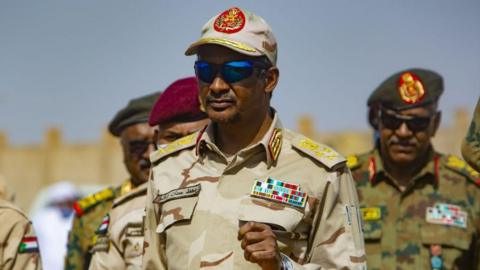
The RSF, led by Mohamed Hamdan Dagalo, had been an ally of the army until the two fell out