The killing was headline news until he was caught, but it was the powerful response of Giulia's sister, Elena, that has endured.
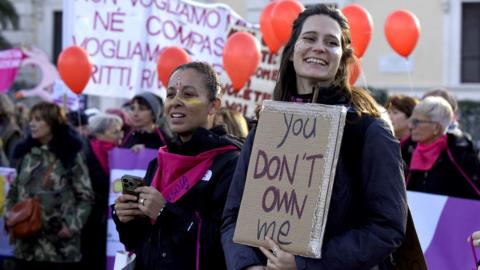
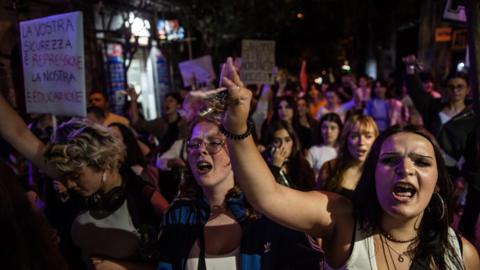
The murderer was not a monster, she said, but the "healthy son" of a deeply patriarchal society. They were words that brought crowds out across Italy demanding change.
Two years on, MPs have voted for a law on femicide after a long and passionately debated session of parliament. It makes Italy one of very few places to categorise femicide as a distinct crime.
Introduced by Prime Minister Giorgia Meloni, the law was backed by her own hard-right government as well as opposition MPs. Many wore red ribbons or red jackets to remember the victims of violence.
From now on, Italy will record every murder of a woman that is motivated by her gender as femicide.
"Femicides will be classified, they will be studied in their real context, they will exist," Judge Paola di Nicola, one of the authors of the new law, said of its significance.
She was part of an expert commission that examined 211 recent murders of women for common characteristics, then drafted the femicide law.
"Talking of such crimes as rooted in exasperated love or strong jealousy is a distortion – that uses romantic, culturally acceptable terms," the judge argues, surrounded by her research at her home in Rome.
"This law means we will be the first in Europe to reveal the real motivation of the perpetrators, which is hierarchy and power."
Italy will now join Cyprus, Malta and Croatia as EU member states that have introduced a legal definition of femicide into their criminal codes.