Wubi News

Our babies were taken after 'biased' parenting test - now we're fighting to get them back

2025-11-24 20:00:10

When Keira's daughter was born last November, she was given two hours with her before the baby was taken into care.

"Right when she came out, I started counting the minutes," Keira, 39, recalls.

"I kept looking at the clock to see how long we had."

When the moment came for Zammi to be taken from her arms, Keira says she sobbed uncontrollably, whispering "sorry" to her baby.

"It felt like a part of my soul died."

Now Keira is one of many Greenlandic families living on the Danish mainland who are fighting to get their children returned to them after they were removed by social services.

In such cases, babies and children were taken away after parental competency tests - known in Denmark as FKUs - were used to help assess whether they were fit to be parents.

In May this year the Danish government banned the use of these tests on Greenlandic families after decades of criticism, although they continue to be used on other families in Denmark.

The assessments, which usually take months to complete, are used in complex welfare cases where authorities believe children are at risk of neglect or harm.
They include interviews with parents and children, a range of cognitive tasks, such as recalling a sequence of numbers backwards, general knowledge quizzes, and personality and emotional testing.

Defenders of the tests say they offer a more objective method of assessment than the potentially anecdotal and subjective evidence of social workers and other experts.

But critics say they cannot meaningfully predict whether someone will make a good parent.

Opponents have also long argued that they are designed around Danish cultural norms and point out they are administered in Danish, rather than Kalaallisut, the mother tongue of most Greenlanders.

This can lead to misunderstandings, they say.

Psychologists who defend the tests argue questions like these are intended to assess parents' general knowledge and their understanding of concepts they might encounter in society.

Keira adds that "they made me play with a doll and criticised me for not making enough eye contact".

She alleges that when she asked why she was being tested in this way the psychologist told her: "To see if you are civilised enough, if you can act like a human being."

The local authority in Keira's case said it could not comment on individual families, adding that decisions to place a child in care were made when there was serious concern about the "child's health, development, and well-being".

In 2014, Keira's other two children - who were then aged nine years and eight months - were placed into care after an FKU test at the time concluded her parenting skills were not developing fast enough to meet their needs.

Her eldest, Zoe, who is now 21, moved back home when she was 18 and currently lives in her own apartment and sees her mum regularly.

Keira hopes she will soon be reunited with her baby Zammi permanently.

The Danish government has said its review will look at whether mistakes were made in the administering of FKU tests on Greenlandic people.

In the meantime, Keira is allowed to see Zammi, who is in foster care, once a week for an hour.

Each time she visits, she takes flowers and sometimes Greenlandic food, such as chicken heart soup.

"Just so a little part of her culture can be with her," she says.

But not all Greenlandic parents who had children taken into care after completing FKUs will have their cases reviewed.

Johanne and Ulrik's son was adopted in 2020 and the Danish government has said it will not review cases where children have been adopted.

Johanne, 43, was tested in 2019 during pregnancy.

Like Zammi, her son was meant to have been taken away immediately after birth.

But because he was born prematurely on Boxing Day and social workers were on holiday, she and her husband Ulrik got to keep him for 17 days.

"It was the happiest time of my life as a father," says Ulrik, 57.

"Being with my son, holding him, changing his nappy, making sure that Johanne pumps her milk before going to bed in the evening."

Then one day, two social workers and two police officers arrived at Johanne and Ulrik's home to take their son away.

The couple say they pleaded with them not to take him.

Johanne asked if she could breastfeed him one last time.

"As I was dressing my son to hand him over to his foster parents who were on their way, I felt the most horrific heartbreak," Ulrik says.

Johanne had been tested after two children from another relationship, who were five and six, were taken into care after FKU testing in 2010.

Her 2019 assessment describes her as "narcissistic" and as having "mental retardation" - a categorisation based on designations developed by the WHO which were in use at the time.

She rejects both of these descriptions of her.

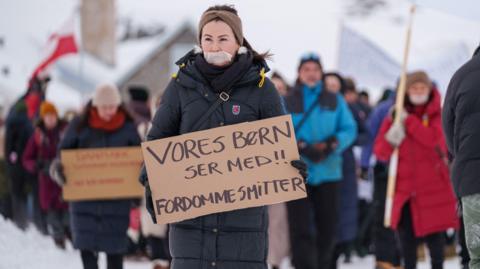
A protester carries a placard that reads: "Our children are watching!! Prejudices are contagious," during a demonstration in Nuuk, Greenland's capital, earlier this year

In theory, there is no pass or fail mark for an FKU and they are one factor among others taken into consideration by local authorities who decide whether to place a child into care.

But psychologist Isak Nellemann, who used to administer the tests, says in practice they "are very important, about the most important thing, because when the tests are bad, in about 90% [of cases] they will lose their children".

Nelleman argues some of the tests lack scientific validity and were developed to study personality traits rather than predict parenting ability.

However, Turi Frederiksen, a senior psychologist whose team currently administers the tests, defends them, saying that while they are not perfect, "they are valuable, extensive psychological tools".

She also says she does not believe they are biased against Greenlanders.

When Johanne was asked in 2019 what she saw during a Rorschach test - a psychological test where people are asked what they see when looking at ink-blot images - she said she saw a woman gutting a seal, a familiar sight in Greenland's hunting culture.

Johanne alleges that on hearing this answer the psychologist called her a "barbarian".

The local council involved in the couple's 2019 assessment did not address Johanne's claim directly.

They said her assessment "indicated significant concern regarding the parents' overall parenting abilities" as well as "concerns about the parents' general lifestyle and functional level in daily life".

Pilinguaq is a rare case of a Greenlandic mother who has been reunited with her child.

She and her daughter, who was placed into care aged one, were reunited a few months ago. Her daughter is now six.

Pilinguaq, 39, says she received the unexpected news in a phone call from social services.

"I started crying and laughing at the same time. I couldn't believe it. I kept thinking, 'Oh my God, she's coming home.'"

Pilinguaq's three children were all placed into care in 2021. The other two were aged six and nine at the time.

She says she agreed for her local authority to place her children in temporary care while she found a new home suitable for her children.

Pilinguaq says she believed her children would soon be returned to her, but instead she had to undergo a parenting assessment.

This concluded she had a pattern of entering "dysfunctional relationships" and was unfit to parent.

A few months after her six-year-old daughter came home, Pilinguaq was told by her local authority that her other two older children will be returning to her in December.

The decision to return the children into Pilinguaq's care was made by the local authority rather than being recommended by the government review. The local authority declined to comment on her case.

Spending more than four years apart has made it difficult for Pilinguaq to rebuild her relationship with her daughter.

"If I go to the bathroom and close the door, she will have a panic attack and say 'Mum, I couldn't find you,'" Pilinguaq says.

She also says she is terrified of losing her daughter again.

"They can take her in one hour. They can do it again."

Keira is now preparing for Zammi's first birthday in her absence.

She's building a traditional Greenlandic sleigh by hand from wood, with a polar bear drawn on the front.

Earlier this month, she was told that her daughter won't be coming home - for now at least - but she hasn't given up hope.

Keira still has a cot next to her bed and another in the living room, with framed photos of Zammi on the walls, along with baby clothes and nappies.

"I will not stop fighting for my children.

"If I don't finish this fight, it will be my children's fight in the future."