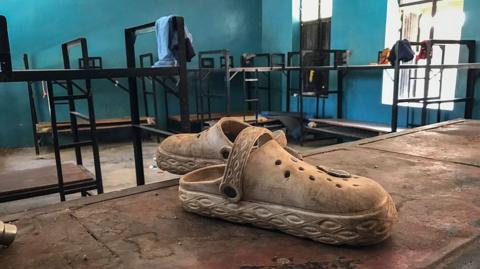
The Nigerian president has postponed foreign trips - including to this weekend's G20 summit in South Africa - in order to address the security concerns.
This week's attacks follows claims by right-wing figures in the US, including President Donald Trump, that Christians are being persecuted in Nigeria.
For months, campaigners and politicians in Washington have been alleging that Islamist militants are systematically targeting Christians. The Nigerian government has dismissed this claim.
Earlier this month, Trump said he would send troops into Nigeria "guns a-blazing" if the African nation's government "continues to allow the killing of Christians".
The Nigerian government has called claims that Christians are being persecuted "a gross misrepresentation of reality".
An official said that "terrorists attack all who reject their murderous ideology - Muslims, Christians and those of no faith alike".
In the north-east, jihadist groups have been battling the state for more than a decade.
Organisations monitoring violence say most of the victims of these groups are Muslim because most attacks happen in the majority-Muslim north of the country.
In the centre of Nigeria, there are also frequently deadly attacks between herders - who are mostly Muslim - on farmers, who are largely Christian.
However, analysts say these are often motivated by competition for resources, such as water or land, rather than religion.
The militant Islamist group Boko Haram took 276 girls from their school in the town of Chibok in 2014.
The incident drew international attention and sparked a global campaign seeking their return, which included an intervention from then-US First Lady Michelle Obama.
Many have since either escaped or been freed, but as many as 100 remain missing.