The most important thing to come out of COP30 is that the climate 'ship' is still afloat
But many participants are unhappy that they didn't get anything close to what they wanted.
And despite a great deal of warmth for Brazil and for President Luiz Inácio Lula da Silva, there is frustration with the way they ran this meeting.
Right from the off there seemed to be a gulf between what President Lula wanted this meeting to achieve, and what COP president President André Corrêa do Lago felt was possible.
So Lula talked of roadmaps away from fossil fuels to the handful of world leaders that came to Belém before the official start of the COP.
The idea was taken up by a number of countries including the UK, and within days there was a campaign to get this roadmap formally into the negotiations.
Do Lago wasn't keen. His north star was consensus. He knew that forcing the issue of fossil fuels on the agenda would rupture that.
While the initial text for agreement had some vague references to things that looked like a roadmap, within days they were gone, never to return.
Colombia and the European Union and around 80 countries tried to find some language that would signal a stronger step away from coal, oil and gas.
To find consensus, do Lago convened a mutirão, a kind of Brazilian group discussion.
It made matters worse.
Negotiators from Arab countries refused to join huddles with those who wanted a pathway away from fossil energy.
The EU were given short shrift by major producers.
"We make energy policy in our capital not in yours," the Saudi delegate told them in a closed-door meeting, according to one observer.
Ouch!
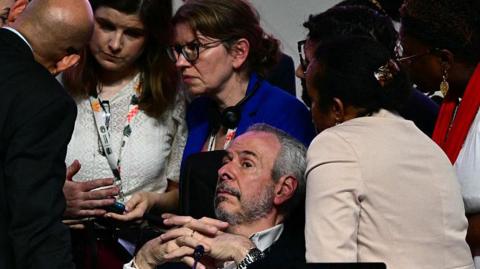
Nothing could bridge the gap - and the talks teetered on the verge of collapse.
Brazil came up with a face-saving idea of roadmaps on deforestation and fossil fuels that would exist outside the COP.
These were heartily applauded in the plenary halls – but their legal standing is uncertain.