Wubi News

COP30 climate talks overrun with deadlock over fossil fuels

2025-11-22 20:00:11
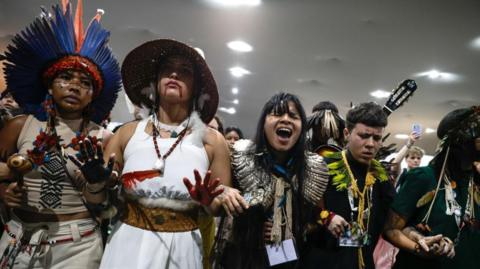
The summit has had a large number of delegates from indigenous groups, but some say they still have not been listened to

Fights over fossil fuels and money appear to have deadlocked the COP30 climate talks, as negotiations ran through the night with no sign of an agreement.

Talks were meant to wrap up by 18:00 local time (21:00 GMT) on Friday - and with many delegates already leaving, time is running out to secure a deal.

Host Brazil had hoped countries would agree to set out how to move away from fossil fuels - but a draft deal released on Friday morning failed to mention coal, oil and gas, whose emissions are the main cause of climate change.

That was unacceptable to a group of countries including the UK, while some poorer nations want stronger commitments on cash to help them cope with rising temperatures.

A closing meeting - or "plenary" - is currently scheduled for 11:00 local time (14:00 GMT).

All countries present at these annual climate talks have to agree in order to pass a deal.

That can be challenging. Different nations have competing priorities, based for example on their dependence on fossil fuels, economic position or vulnerability to climate change.

As a result, the conference usually overruns, sometimes by more than a day.

But two-thirds of countries signed up to the UN climate convention must be present for decisions to be made, according to UN rules.

And with many delegates due to leave over the coming hours, the clock is ticking for countries to come to an agreement.

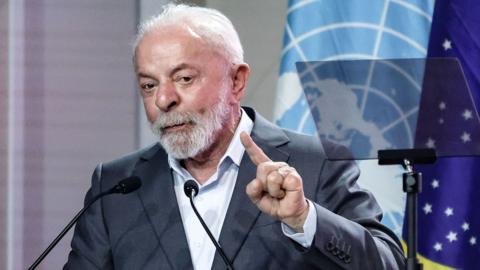
Brazilian President Lula called for countries to show greater ambition at the talks

Brazil's President Luiz Inácio Lula da Silva wanted the talks to secure clearer steps for how countries would move away from coal, oil and gas.

"The world needs a clear roadmap to end its dependence on fossil fuels," he said ahead of the talks.

It would advance a deal made two years ago, at COP28 in the United Arab Emirates, where countries agreed on the need to "transition away from fossil fuels in energy systems".

The idea of a "roadmap" had been backed by dozens of countries, including the UK, but strongly opposed by oil-producing nations.

Some of these countries argue they should be allowed to exploit their fossil fuel reserves as others have done in the past.

And they have often called for the focus to be on reducing emissions, rather than fossil fuels themselves, through technology like carbon capture.

Many scientists have criticised that approach for failing to tackle the problem at source.

Some developing countries have not backed the fossil fuel deal, because they want richer nations to first deliver money to help them adapt to the impacts of climate change. Richer nations have historically underdelivered on those promises.

Poorer countries have repeatedly called for greater support, arguing they are facing the worst impacts of climate change despite bearing relatively little responsibility for rising temperatures.

The latest version of the agreement, released on Friday morning, had not a single mention of fossil fuels, which was viewed as unacceptable by many nations.

On Friday, UK Energy Security and Net Zero Secretary Ed Miliband said he was determined to keep the plan for a roadmap away from fossil fuels "alive" in "one way or another".