Wubi News

Nvidia shares soar after revenue tops estimates

2025-11-20 07:00:09
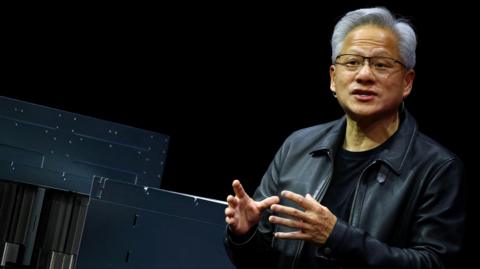
Chief executive Jensen Huang said sales for some of Nvidia's AI components were "off the charts"

Chip giant Nvidia has reported stronger-than-expected revenues, easing investor concerns about heavy artificial intelligence (AI) spending that have unsettled markets.

The company said revenue for the three months to October jumped 62% to $57bn, driven by demand for its chips used in AI data centres. Sales from that division rose 66% to more than $51bn.

Fourth-quarter sales forecasts in the range of $65bn also topped estimates, sending shares in Nvidia about 4% higher in after-hours trading.

"There's been a lot of talk about an AI bubble. From our vantage point, we see something very different," said chief executive Jensen Huang.

In a statement, Mr Huang said sales of its AI Blackwell systems were "off the charts" and that "cloud GPUs [graphics processing units] are sold out".

"We excel at every phase of AI."

Nvidia, the world's most valuable company, makes chips that are crucial for AI data centres and is seen as a bellwether for the AI boom.

Its latest results were under even more attention than usual on Wall Street amid mounting concern that AI stocks are overvalued - fears that may persist despite the blockbuster results.

Those fears had fuelled four consecutive daily drops in the S&P 500 index leading up to Wednesday, as questions swirl about returns on AI investments. The benchmark index has fallen nearly 3% so far in November.

Some analysts have compared the surge in AI stocks to the dotcom boom of the late 1990s. This saw the values of early internet companies soar amid a wave of optimism over the then-new technology before the bubble burst in early 2000.

This collapse in share prices led to some companies going bust, and also hit the value of people's savings including their pension funds.

The bar was high heading into Nvidia's results.

Adam Turnquist, chief technical strategist for LPL Financial, said the question was not whether the company would beat expectations, "but by how much".

Matt Britzman, senior equity analyst at Hargreaves Lansdown, said: "While AI valuations are dominating the news feeds, Nvidia is going about its business in style."

He said valuations for certain areas of the AI sector "needed to take a breather, but Nvidia is not in that camp".

Mr Huang had previously said he expected $500bn in AI chip orders through next year. Investors were looking for details about when the company expects those revenues will come to fruition, and how it plans to fulfill the orders.

Colette Kress, Nvidia's chief financial officer, told analysts the company would "probably" be taking more orders on top of the $500bn that had already been announced.

But she also expressed disappointment about regulatory limits that stymie the company's ability to export its chips to China, saying the US "must win the support of every developer" including those in China.

She said Nvidia was "committed to continued engagement" with the American and Chinese governments.

Earlier on Wednesday at the US-Saudi Investment Forum in Washington, Mr Huang joined Elon Musk to announce a massive data centre complex in Saudi Arabia that will have Musk's AI company, xAI, as its first customer.

The facility will be outfitted with hundreds of thousands of Nvidia chips.

The Wall Street Journal reported the US Commerce Department has approved the sale of up to 70,000 advanced AI chips to state-backed companies in Saudi Arabia and the United Arab Emirates, reversing an earlier decision.

The agreement was brokered following talks between US President Donald Trump and Saudi Arabia's Crown Prince, Mohammed bin Salman, who visited the White House this week.
Last month Nvidia became the first company to be valued at $5tn

Eileen Burbidge, a tech investor and founding partner at Passion Capital, told the Today programme: "A lot of what is fuelling some of the scepticism or concern about a bubble is that there is seen to be a lot of circular deals going on, whereby Nvidia is committing to invest in a company which in turn is committing to invest in Nvidia or is committing to buy Nvidia chips.

"So it goes round and round, maybe with one or two other people inside the circle, but yes it is about 10 to 20 companies that all seem to have these deals going back and forth."

Additional reporting by Lily Jamali, North America Technology Correspondent, San Francisco