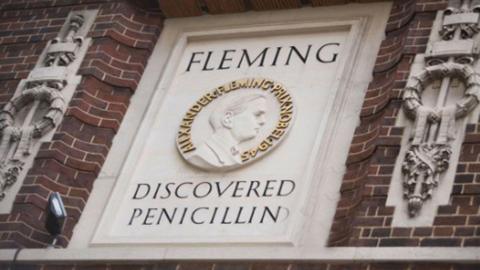
The Fleming Initiative is named after Alexander Fleming, who discovered penicillin in 1928 and started the antibiotic age.
Even by the time he won the Nobel Prize in Physiology or Medicine 80 years ago, he had warned of the dangers of resistance.
Alison Holmes, the director of the Fleming Initiative, said antibiotics were "one of the greatest health resources that has been squandered" and we should all think of how much we owe to antibiotics.
"Whether it's that time we stepped on a nail and or got cellulitis following an insect bite or our C-section wound, or our UTI, or our STI - we all depend on them," she said.
The collaboration will also use AI like a weather forecast to predict how superbugs emerge and spread.
And the project is also looking beyond bacteria to use AI to tackle the rise of deadly fungal infections, starting with Aspergillus mould.
Its spores are normally harmless, but can become deadly in people with weakened immune systems.
Tony Wood, the chief scientific officer at GSK, said: "We will open up new approaches for the discovery of novel antibiotics as well as anticipate and outpace the development of resistance to transform the treatment and prevention of serious infections."
Researchers in the US and Canada have already started using AI to shortlist drugs or even design antibiotics from scratch to target drug-resistant bacteria like gonorrhoea.
Data for the UK suggests nearly 400 new antibiotic-resistant infections are being detected every week.