Wubi News

From florist to drone maker: How the weapon became so mainstream

2025-11-15 07:00:04
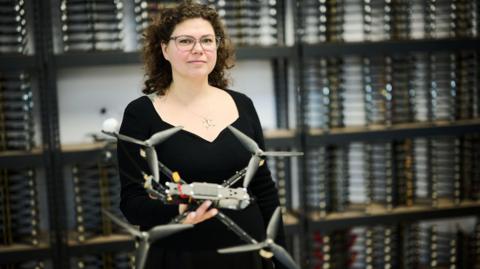
Kseniia Kalmus started to make drones for the Ukrainian army after Russia's invasion

Combat drones, delivery drones, surveillance drones, underwater drones – drones have become a key weapon of war globally, whether it be small hand-operated quadcopters, or high-tech military drones that look like small, unmanned aeroplanes and can travel long distances and cause enormous damage on impact.

Before 2022 there were just a handful of companies in Ukraine making drones. Now, there are hundreds. Kyiv says that around three-quarters of Russian losses on the battlefield are caused, not by bullets or conventional artillery, but by drones.

"This has been the first full-blown drone war," says Stacie Pettyjohn, director of the defence program at the Center for a New American Security in Washington, and the author of several reports on drone warfare.

"There are a ton of mom-and-pop shops in Ukraine where people are making drones and assembling them in their apartments, in their garages and donating them to the forces. They've become the go-to weapon for the Ukrainians."

And not just the Ukrainians. Drones are increasingly being used in conflicts from the Middle East, to Myanmar and Sudan.

"You see European states talking about building drone walls and other countries seeking to acquire drones because they provide them with a cheap form of air power." Ms Pettyjohn says.
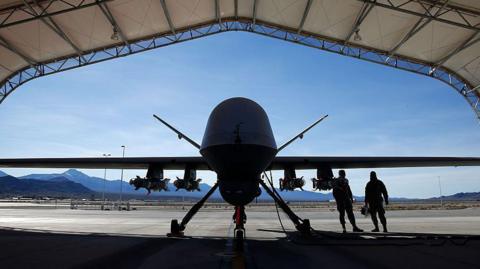
Military drones vary in size from handheld to this large Reaper operated by US Air Force

The world's biggest defence contractors, like Lockheed Martin and Boeing, are taking note, as are smaller drone-makers like US-based AeroVironment, which is listed on the Nasdaq stock exchange. Its share price has soared more than four-fold since Russia's full-scale invasion of Ukraine.

In Europe, Portugal's Tekever became what is known as a unicorn company this year – valued at more than $1bn (£760m) – and Germany's Stark is expanding its drone-making operations. It is due to open a new factory in Swindon in southwest England at the end of November.

Meanwhile, the UK government announced last year that it would be spending £4.5bn on new military drones.

"The sector is growing really quickly," said Mike Armstrong, Stark's managing director for the UK. "I think drones are the future of warfare. Legacy systems – artillery, tanks – they all have a place, but what we've seen is a major innovation which is not going away anytime soon."

The growth in drone use for military ends has spawned its antithesis – a counter-drone industry. For every drone launched in anger on the battlefield, there is usually someone trying to jam its radio signal or shoot it down.

Anti-drone technology is also increasingly being sought by Western nations to protect key infrastructure sites. The Belgian government announced on 7 November that it was urgently trying to acquire drone defences after drone sightings forced it to temporarily close Brussels Airport.

Oleg Vornik is the CEO of DroneShield, an Australian counter-drone company.

"We make hardware and software that you can carry in your hands, you can put on a vehicle or around the edge of a military base to detect and safely take down small drones," he says.

Since 2022, DroneShield's share price has soared 15-fold. "We are the only public-listed counter-drone company around the world, which has helped us," Mr Vornik adds.

As well as supplying Ukraine, Mr Vornik says DroneShield is seeing increased interest from countries in the Asian Pacific, worried about China's use of surveillance drones. DroneShield also sells to the governments of Colombia and Mexico, which use its technology to protect facilities from the use of drones by criminal gangs.

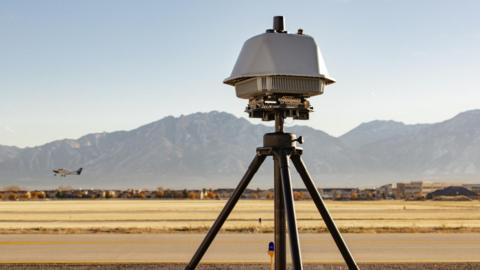
DroneShield makes technology, such as this sensor, which can detect drones in the sky above

Munin Dynamics is a much smaller start-up working in the same counter-drone space. Its founder is Magnus Freyer, a former paratrooper in the Norwegian army.

"We're building a system that every soldier, whether they are a newly mobilised Ukrainian or an experienced Nato soldier, can use to defend themselves from drones," he says. "It's a small system that you can have a couple of in your vest, to shoot down the drone when it's coming in."

Experts say the next big development in drone technology is likely to be driven by artificial intelligence (AI).

At the moment, many drones used in conflicts are small, cheap devices that have to be guided to their targets by an operator – a human being with a remote control who needs to be within range of the drone, potentially placing them in danger.

But Ms Pettyjohn says that will change. "That is going to be the next real shift.

"Right now, really smart artificial intelligence is not very extensive. But you are going to start seeing groups of drones controlled by one operator, and then eventually fully autonomous drones that can collaborate."

In the meantime, former floral artist Kseniia Kalmus says she will continue to assemble drones for use on the front line.

"I miss flowers very much and I miss that previous life, of course," she says. "A lot of my friends, me as well, changed totally, from flower artists or from dancers to drone producers.

"But this is a question of existence. We just fight for our country, for our existence, for our culture."