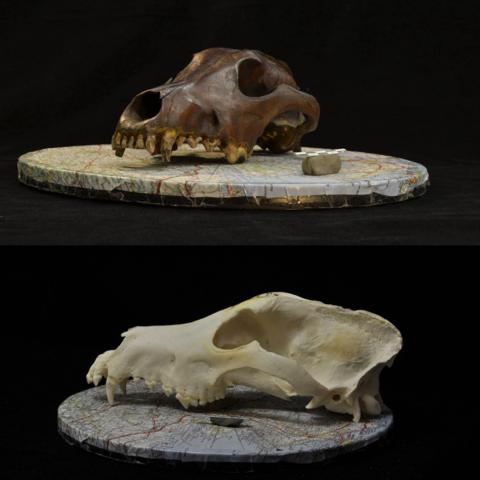
Dogs were the first animals to be domesticated. There is evidence that humans have been living closely with canines for at least 30,000 years. Where and why that close association began remains a puzzle.
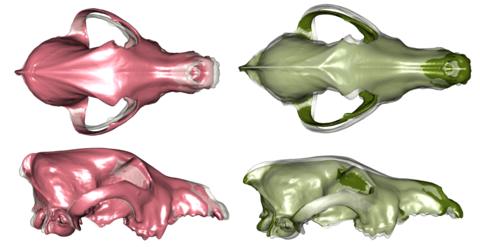
This study has revealed some of the earliest physical evidence of dogs transforming into the diverse array of pets, companions and working animals that we know today. And the researchers' digital scans of the skulls that they studied will allow them to answer more questions about the evolutionary driving forces behind domestication.
Some researchers have suggested that humans and wolves came together almost by accident, when wolves moved to the outskirts of hunter-gatherer communities to scavenge for food.
Tamer wolves would get more food, and the humans gradually came to rely on the wolves to clean up remains of messy carcasses and to raise the alarm if a predator came near.
As to why that ultimately changed dogs' physical appearance, Dr Ameen said there were likely to be a number of reasons. She did not rule our ancestors preference for boxy heads and cute, snub noses but she explained: "It's likely to be a combination of interaction with humans, adapting to different environments, adapting to different types food - all contributing to the kind of explosion of variation that we see.
"It's hard to untangle which of those might be the most important one."
For tens of thousands of years, our human story and that of our dogs has been entangled. In another paper in this same edition of the journal Science, a research group led by scientists in China studied ancient DNA from dogs that lived between 9,700 and 870 years ago - at sites across Siberia, the Central Eurasian Steppe, and northwest China.
They concluded that the movement of domestic dogs across that region often coincided with migrations of people - hunter-gatherers, farmers, and pastoralists. So our dogs have travelled alongside us - and been integrated into our societies - for thousands of years.
I can't say that my own stubborn, disobedient terrier provides me with any of the benefits that the first domesticated wolves bestowed on our ancestors. But I can see why, as research suggests, once a dog showed up for some leftovers, there was no going back.