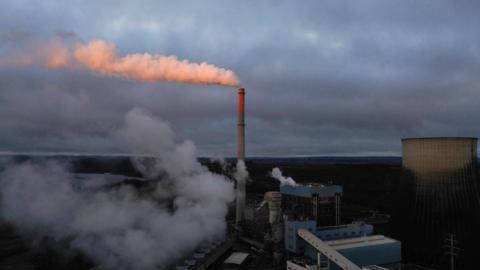
What happens in the power sector is particularly important in the fight against climate change.
It is the single biggest emitting sector and is expected to play an increasing role in the energy system as more people buy electric cars, heat pumps and other technologies.
"Whatever happens in the power sector has an outsized influence on what happens for emissions worldwide," said Mr Fulghum.
Ember is confident that emissions from using fossil fuels to generate electricity are now plateauing and could begin a permanent decline in a few years.
That echoes yesterday's message from the International Energy Agency, the global energy watchdog.
Carbon emissions from energy systems – more than just electricity - could peak within the next few years, based on countries' stated policies, it said.
While there is still uncertainty about the exact timing of a peak, it would undoubtedly be a landmark moment in the fight against climate change.
It would not halt warming, however, as countries would still be adding CO2 to the atmosphere - just at a slower rate.
"As long as we emit CO2, the warming will continue… to stop further warming, we have to bring [net] emissions to zero," said Prof Pierre Friedlingstein, chair in mathematical modelling of climate systems at the University of Exeter.
And another analysis released today to coincide with COP30 offers a reality check.
The Climate Action Tracker research group finds that warming could reach 2.6C above pre-industrial levels by the end of the century based on current policies – a figure which has barely changed over the past few years.
"It's very clear that we have never had a better chance to do this. It's also clear that we've never been in a worse situation," said Dr Bill Hare, from the Climate Action Tracker team.
"So it's a diabolical dilemma. Things could go really badly. We could walk away from this COP without taking the right kind of action, and entrenching fossil gas and oil, and we'll push towards 2.5C [or] 3C warming for sure," he added.
"But on the other hand, the chance is there… to do exactly the opposite, and to build on the momentum of the technology changes going on globally."