Wubi News

SSE to invest £33bn in upgrading Scotland's electricity grid

2025-11-13 04:00:02
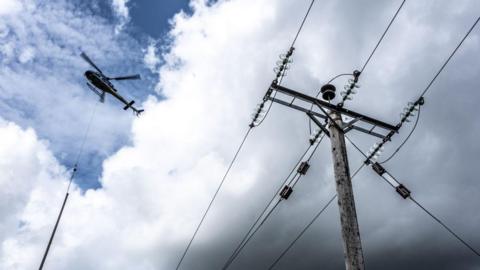
SSE's plans include erecting tall pylons and and building large sub-stations

The company that controls the electricity grid in the north of Scotland has announced plans to invest £33bn over five years.

SSE has set out plans to spend two-thirds of that to upgrade wiring and increase high-voltage grid capacity to get power from the north to customers in the south.

However, the Perth-based company faces strong criticism of some its plans, for the impact they will have on the Highlands and rural Aberdeenshire.

The plans include erecting tall pylons and and building large sub-stations.
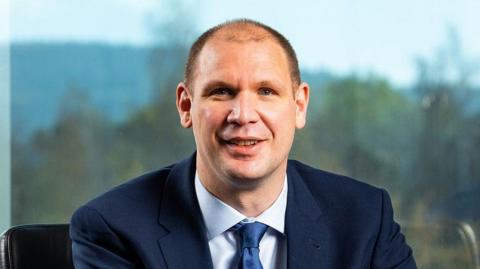
Martin Pibworth, SSE's chief executive, says he is confident Scotland has sufficient skills to support the plans

The other third of the new investment plan is partly for lower-voltage wiring in the two areas where the company has the distribution franchise and monopoly - the north of Scotland and central southern England, where it took over Southern Electric 27 years ago.

That will take £5bn of the investment plan up to 2030, some of it to improve the capacity of homes to run air heat converters and car charging through household meters.

The company is putting a reduced share of its investment effort into offshore wind power, though it remains a major developer in the North Sea.

SSE is constructing the Dogger Bank wind farm, which will be the world's largest, and it has permission to build the Berwick Bank array, off the south-east coast of Scotland, which will then become the world's largest when it is completed.

Martin Pibworth, the company's new chief executive, is confident that the plan is "focussed, disciplined and comprehensively funded".

That funding process began with the successful placing, on Tuesday morning, of £2bn-worth of new SSE shares, taken up by existing investors. Unusually for a utility, its share price rose nearly 16% at its peak, before ending the day 11% up.

Other funding will come through the company's income from its current assets, and from debt.

SSE is also behind the The Dogger Bank scheme off the East Yorkshire coast

Mr Pibworth, who took over from Alistair Phillips-Davies as chief executive of SSE three months ago, is also confident that there will be sufficient skills to carry out the work.

The networks transmission division is expanding its staff five-fold to 2,500 by shifting people within SSE, while recruiting apprentices, graduates and seeking out those in the offshore oil and gas industry.

More widely, SSE directly employs 7,000 people in Scotland, and more than 10,000 indirectly, while that extends to a total of nearly 49,000 across the UK.

However, the company faces criticism about the scale of the 11 major transmission projects it has under way - similar to the difficulties in winning community support for grid connections in England and Wales, where National Grid plc runs the network, and in the south of Scotland, where the monopoly provider of high-voltage cabling is Scottish Power.

He conceded there is growing political debate about the affordability of the transition to green power, but responded: "There is no doubt in my mind that renewables represent the lowest cost of energy to the consumer, that it's in the best interests of the consumer to build out the infrastructure we're building out.

"It is clean. It is green. I'm absolutely confident we're on the right path."

He also praised the UK and Scottish governments for their role in supporting further renewable energy development, saying the UK has become the best market for such investments, where other countries have scaled back their ambitions.

SSE recently announced it has a target for building 1,000 new homes because it is unable to find accommodation for the workers needed to install new infrastructure.

After the work is done, the homes will be handed over for sale as affordable homes or for social housing.

Its investment plan was welcomed by Sir Keir Starmer during Prime Minister's Questions in the House of Commons.