Wubi News

Cryptoqueen who fled China for London mansion to be sentenced over £5bn Bitcoin stash

2025-11-11 09:00:07
Qian Zhimin enjoyed a lavish lifestyle of travel and shopping before UK police discovered her stash of crypto
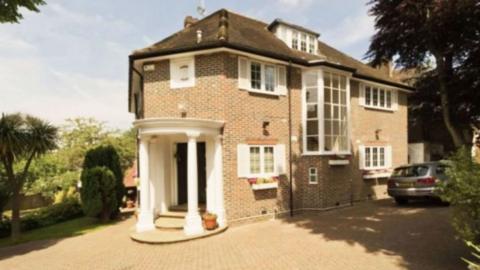
On fleeing China, Qian rented this house in Hampstead

As Bitcoin rocketed in value, Qian could achieve what her company promised its investors - that they could "get rich while lying down". Her assistant Wen Jian - at her own trial last year, which culminated in a six-year jail term for money laundering - said Qian had spent most of her days lying in bed, gaming and online shopping.

But Qian was also drawing up a bold six-year plan for future schemes, according to her diary. Her notes outline plans to found an international bank, buy a Swedish castle, and even to ingratiate herself with a British duke.

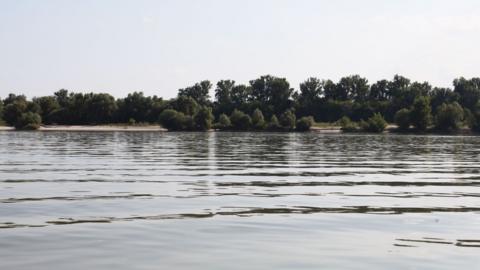
Her grander stated objective was to become queen of Liberland, an unrecognised microstate on the Croatian-Serbian border, by 2022.

In the meantime, Qian had Wen look for houses she could buy in London. But her attempts to purchase an especially large property in Totteridge Common - an area known for its substantial, secluded residences - triggered a police investigation when Wen was unable to account for her boss's wealth.
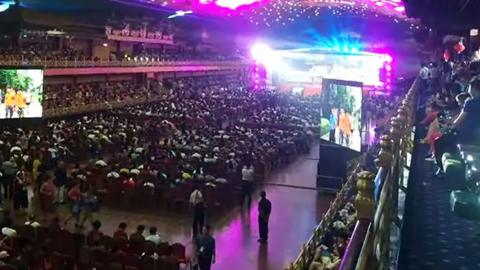
Qian Zhimin's company staged huge meetings and banquets for current and prospective investors in China

Investors saw their daily payouts topped up for each new person they signed up. This helped the scam reach some 120,000 people, based in every one of China's provinces, according to documents from trials in China of the company's official promoters. Their deposits totalled more than 40bn yuan ($5.6bn, £4.2bn), the UK's Crown Prosecution Service (CPS) has found.

A former company employee later testified that it was new investors' money that had been funding the daily payouts, not crypto-mining dividends.

Lantian Gerui's marketing exploited the loneliness of many middle-aged and elderly Chinese. Qian wrote poems about social responsibility, with lines such as: "We must love the elderly with the infatuation of a first romance."

The company also organised mass holidays and banquets for current and potential investors. These were used to promote yet more investment opportunities - slideshows and card machines at the ready.

Lantian Gerui also trumpeted its love of China as a nation, another ploy calculated to appeal to the elderly.

"Our patriotism was our Achilles' heel, that's what they exploited," says Mr Yu, who is in his 60s. "They said that they wanted to make China number one in the world."

A range of speakers endorsed the company, including the son-in-law of the late Chairman Mao, the founding father of the People's Republic of China - Mr Yu said.

"We in our generation all looked up to Chairman Mao, so if even his son-in-law was vouching for it, how could we not trust it?"

The company even held an event in the Great Hall of the People, where China's legislature meets, according to an investor who attended the event and two others we spoke to.

"That bunch of [promoters], they'd take something red and persuade you it was white, take something black and convince you it was red," Mr Yu says.

Despite leading this high-profile enterprise, Qian was notoriously secretive, known only as Huahua or Little Flower to her clients, and communicating with them largely through the poems she posted on her blog.

But she would emerge for the biggest investors - those who put in at least 6m yuan ($842,000, £628,000) - inviting them to more intimate events, according to one of these clients, Mr Li.

"Those of us present, you could say that we were starstruck," he remembers. "We all saw her as our Goddess of Wealth.

"She started encouraging us to dream big… that within three years, she'd give us enough wealth to last our families three generations."

Mr Li, his wife, and his brother, invested some 10m yuan ($1.3m, £1m) between them.

Qian was aiming to become queen of Liberland - 7 sq km of uninhabited marshland on a western bank of the River Danube

A Chinese police investigation into Lantian Gerui, launched in mid-2017, signalled the beginning of the end for Qian's scheme.

"The payouts suddenly stopped," Mr Yu recalls. "The company said the police were doing some checks… though we were promised that payments would resume soon enough."

What helped the investors initially keep calm, he says, was company managers' reassurance that this was just a temporary blip, urging them not to approach the police.

What he later discovered through the Chinese court cases, he says, is that Qian had paid off those senior managers to assuage investors' concerns - while she fled to the UK with the money.

Qian was not entirely oblivious to the plight of her investors - she outlined a plan in her diary to pay back her debts in China, once the price of Bitcoin had reached £50,000 per coin. But her diary makes clear that her priority was to rule and develop Liberland, earmarking millions of pounds for this project.

When she was finally arrested in York, in the north of England, last April, police also found four other people at the house, Southwark Crown Court heard at the start of her sentencing hearing on Monday. All four had been brought to the UK specifically to work for Qian in roles such as shopping, cleaning and security - and were employed illegally, the court was told.

At the time of her arrest, Qian denied all charges, claiming she was simply fleeing a Chinese government crackdown on crypto entrepreneurs, and disputing evidence presented by the Chinese police. But then, at her trial in September, she unexpectedly pleaded guilty to illegally acquiring and possessing the cryptocurrency.