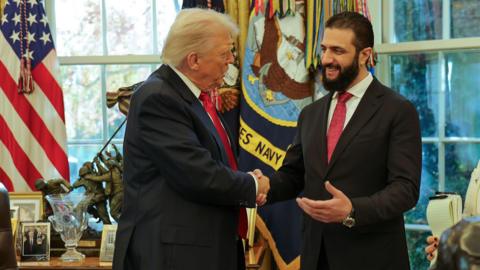
As part of the measures, the administration is also issuing an 180-day suspension of the Caesar Act, which since 2019 had sanctioned the former Syrian government.
Speaking to reporters in the Oval Office several hours after the meeting, Trump said that "we want to see Syria become a country that's very successful."
"And I think this leader can do it," he added. "I really do."
Diplomatic relations between Syria and the US have been suspended since 2012, although the US will now allow Syria to re-open its embassy in Washington.
This is the third meeting between the two leaders, following one in May on the sidelines of the Gulf Cooperation Council and a dinner during the UN General Assembly in September.
Al-Sharaa's visit to the White House caps a remarkable re-branding for the former jihadist.
Not long ago, he led a branch of Al-Qaeda - the group behind the 9/11 attacks and many others - before breaking off ties.
Even until this year, he was the leader of Hayat Tahrir al-Sham, an armed Islamist group which the US officially considered a terrorist organisation until four months ago, with a $10m bounty on his head.
The Treasury Department removed al-Sharaa from its "specially designated global terrorist list" just last week.
But since becoming interim Syrian president, al-Sharaa has worked to soften his public image as he tries to rebuild Syria, with foreign support, following 13 years of war.
"He has had a rough past," Trump said on Monday. "And I think, frankly, if you didn't have a rough past, you wouldn't have a chance."
In his interview, al-Sharaa said that he and Trump had not discussed his past, but instead focused on the "present and the future" of Syria in which it was a "geopolitical" and economic partner of Washington.
Al-Sharaa's rule, however, has been marred by killings of members of Syria's Alawite minority, as well as by deadly violence between Sunni Bedouin fighters and Druze militias.
He has vowed to root out members of his security forces that have committed human rights violations.
Trump, for his part, has repeatedly expressed support for al-Sharaa, referring to him as a "young, attractive guy" and a "fighter".
In June, President Trump signed an executive order lifting sanctions against Syria, which the White House said would help support the country's "path to stability and peace".
At the time, the administration said it would monitor the new Syrian government's actions, including "taking steps toward normalising ties with Israel" and addressing "foreign terrorists" and militant groups operating in the country.