Wubi News

Dundee and US surgeons achieve world-first stroke surgery using robot

2025-11-10 17:00:13
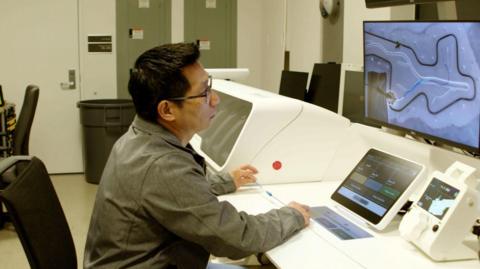
Prof Iris Grunwald demonstrates the technology which she says now shows that a specialist doesn't need to be "in the same hospital, or even in the same country, to help you"

Doctors from Scotland and the US have completed what is thought to be a world-first stroke procedure using a robot.

Prof Iris Grunwald, of the University of Dundee, performed the remote thrombectomy - the removal of blood clots after a stroke - on a human cadaver that had been donated to medical science.

The professor was at Ninewells Hospital in Dundee, while the body she was operating on while using the machine was across the city at the university.

Hours later, Ricardo Hanel - a neurosurgeon in Florida - used the technology to carry out the first transatlantic surgery from his Jacksonville base on a human body in Dundee over 4,000 miles (6,400km) away.
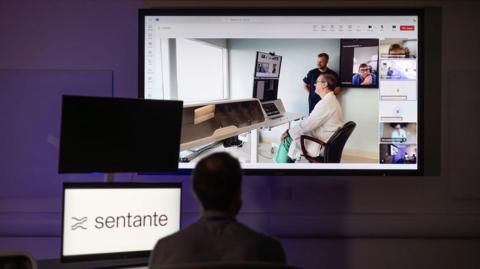
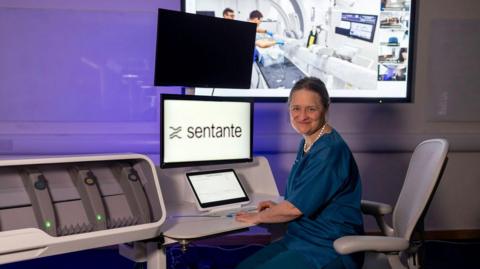
The team watch on as Ricardo Hanel performs the procedure from Florida
Prof Grunwald says the new technology "could make expert stroke treatment available to everyone"

In the experiment, fluid which mimics human blood was used in four different cadavers.

The subjects, who donated their bodies to science, died within the past three years and were then embalmed.

Both the Dundee and Florida procedures were carried out last month using robotics from the Lithuanian firm Sentante.

While there have been remote thrombectomies carried out before on a silicon model, a 3D printed replica and on an animal, this is thought to have been the first procedure on a human body.

The team now hope to take part in clinical trials next year.

An ischaemic stroke occurs when an artery is blocked by a clot.

This cuts off blood and oxygen supply to the brain, and brain cells lose function and die.

The best treatment is a thrombectomy, where a specialist uses catheters and wires to remove the clot.

But what happens when a patient can't get to a specialist who can do the procedure?

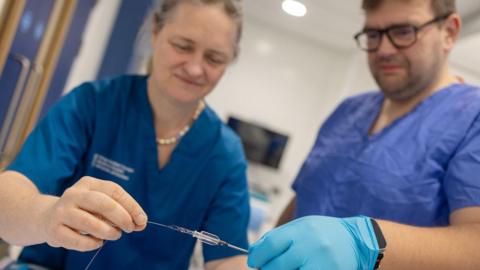
Prof Grunwald said the experiment demonstrated a robot could be connected to the same catheters and wires a surgeon would normally use, and a medic who is with the patient could simply attach the wires.

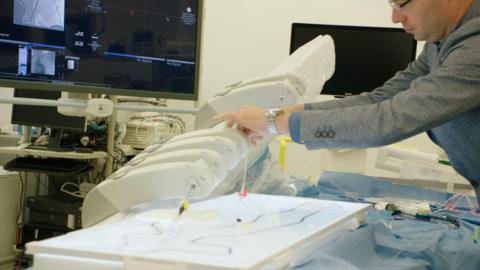
The surgeon, in another location, could then hold and move their own wires, and the robot then carries out exactly the same movements in real time on the patient to carry out the thrombectomy.

The patient would be in a hospital operating room, while the doctor could carry out the procedure using the Sentante machine from anywhere - even their own home.

Prof Grunwald and Ricardo Hanel could see live X-rays of the body in the experiments, and monitor progress in real time, with the Dundee expert saying it took only took 20 minutes of training.

Tech giants Nvidia and Ericsson were involved in the project to ensure the connectivity of the robot.

Dr Hanel said: "To operate from the US to Scotland with a 120 millisecond lag - a blink of an eye - is truly remarkable."

In this earlier demonstration of the technology, it shows how a doctor - who could be anywhere - can move the wires, and the technology records the movements
In this same demo, the robot - which could be attached to a patient - replicates the movement of the remote surgeon