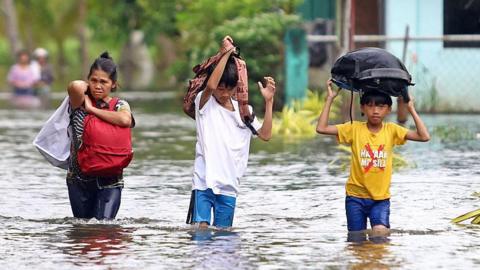
The Philippines government declared a state of calamity across the country after Typhoon Kalmaegi and in preparation for the coming storm.
It has given government agencies more power to access emergency funds and fast-track the procurement and delivery of essential goods and services to those in need.
For some Filipinos, the devastation wrought by Typhoon Kalmaegi earlier this week has left them even more anxious about the storm to come.
"We decided to evacuate because the recent typhoon brought floods in our area, and now I just want to keep my family safe," Norlito Dugan told the AFP news agency.
He is among those who have taken shelter in a church in the city of Sorsogon in Luzon.
Another resident, Maxine Dugan said: "I'm here because the waves near my house are now huge, I live near the shore. The winds there are now very strong, and the waves are huge."
The Philippines is one of the most vulnerable countries in the world to tropical cyclones, due to its location on the Pacific Ocean where such weather systems form.
About 20 tropical cyclones form in that region every year, half of which impact the country directly.
Climate change is not thought to increase the number of hurricanes, typhoons and cyclones worldwide.
However, warmer oceans coupled with a warmer atmosphere - fuelled by climate change - have the potential to make those that do form even more intense. That can potentially lead to higher wind speeds, heavier rainfall, and a greater risk of coastal flooding.