
Wubi News

UK seeks Danish inspiration to shake up immigration system

2025-11-08 15:00:03
Shabana Mahmood sent officials to Denmark to study its immigration system

Denmark's tighter rules for family reunions have also attracted the interest of UK Home Office officials.

If you are a refugee who has been given residency rights in Denmark, both you and your partner who is applying to join you in the country must be 24 or older.

The Danish government says this is to guard against forced marriages.

The partner in Denmark must not have claimed benefits for three years and also has to put up a financial guarantee - and both partners have to pass a Danish language test.

Refugees who live in housing estates designated as "parallel societies" - that is where more than 50% of residents are from what the Danish government considers to be "non-Western" backgrounds - will not be eligible for family reunion at all.

This law, which also allows the state to sell off or demolish those apartment blocks that fall under the "parallel societies" designation, has been controversial. Denmark's government said it was aimed at improving integration, while a senior adviser to the EU's top court described it earlier this year as discriminatory on the basis of ethnic origin.

In September, the UK Home Office suspended new applications under the Refugee Family Reunion scheme, pending the drafting of new rules.

The pre-September scheme allowed spouses, partners and dependents under 18 to come to the UK without fulfilling the income and English-language tests that apply to other migrants.

Mahmood is unlikely to go as far as Denmark when she announces the UK's replacement rules for family reunions, but it seems likely that she will take steps along a more restrictive route.
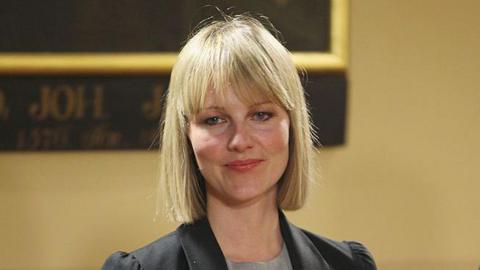
According to Stoklund, tighter immigration and integration is about protecting the societal nature of Denmark, which is a smaller country with a lower population than the UK.

"We expect people who come here to participate and contribute positively and if they don't, they aren't welcome," he said.

In Denmark - as in the UK - there is a live political debate on whether the European Convention on Human Rights (ECHR) makes the expulsion of foreign criminals more difficult.

Like the UK government, Stoklund does not want to leave the ECHR but believes changes could be made.

The Danish government has launched a review into how this could be done and Stoklund agreed he could make common cause with his British counterparts.

"I think it's very positive every time I hear that other countries have the same concerns and are frustrated the same way as many of us in Denmark are."

Mahmood is said to be keen to meet Stoklund at the earliest opportunity.

Ida Auken says a tougher stance on immigration neutralises a toxic issue

For Labour ministers, there are political as well as practical lessons to learn from Denmark.

In 2015, the country had a centre-left government in trouble and a right-wing populist party surging in the polls, with immigration increasingly worrying voters.

There are parallels with the UK today, as Reform UK maintains its polling lead over Labour.

Downing Street is interested in how a centre-left party managed to defeat the Danish People's Party, one-time allies of Nigel Farage's UKIP in the European Parliament, to return to power.

Ida Auken, the Social Democrats' environment spokesperson, said adopting a tougher stance on immigration meant there was space to pursue progressive policies in other areas.

"For us, it was a licence to operate on the things we want to do," she said.

"We want to have a workforce that are educated, that have a social security and we do want to do a green transition.

"And we would never have been able to do this unless we've had those strict migration policies."

Some senior ministers in the UK are thought to find that argument persuasive.

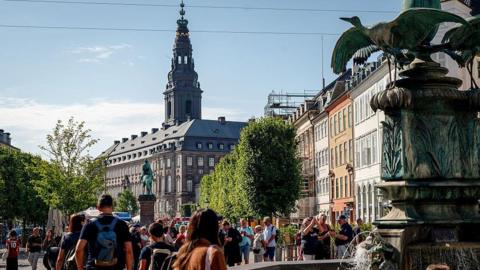
UK officials have been spending time in Copenhagen

Critics would point out that while there are similarities with the UK, the situation in Denmark is different.

The country is not facing small boats arrivals from the North Sea or the Baltic.

Danish is not as widely spoken as English, so language requirements likely discourage some potential refugees.

And while the vast majority of Social Democrat parliamentarians were on board for more hardline policies, there is far more wariness amongst some Labour MPs.

Off the record, some mainstream Labour MPs say they would oppose the transplantation of Danish policies to the UK.