Wubi News

'They went and never came back': Honouring Kenya's forgotten World War soldiers

2025-11-08 09:00:01
Thousands of Kenyan soldiers fought in the British army during the world wars

One day, some 85 years ago, Mutuku Ing'ati left his home in southern Kenya and was never seen again.

The 30-something Mr Ing'ati had disappeared with no explanation - for years his family desperately tried to track him down, following lead after lead that would eventually dry up.

As decades passed, memories of Mr Ing'ati faded. He had no children and many of those close to him passed away. But then, roughly eight decades later, his name re-emerged in British military records.

The Commonwealth War Graves Commission (CWGC), which works to commemorate those who died in the two world wars, contacted Mr Ing'ati's nephew, Benjamin Mutuku, after mining old documents.

He learnt that on the day his uncle left his village, Syamatani, he travelled roughly 180km (110 miles) westwards to Nairobi - the seat of the British colonial government then in control of the country.

There, he signed up as a private with the East African Scouts, a regiment in the British army that fought in World War Two. The UK recruited millions of men from its empire to fight in both of the 20th Century's global conflicts in theatres across the world.

Mr Ing'ati responded to the call for recruits - when exactly is not clear - and then on 13 June 1943, he was killed in action, according to the records unearthed by CWGC. Where and how he died is not known.
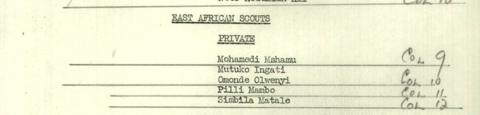
A document lists some of those who enlisted with the East African Scouts
Benjamin Mutuku, named after his uncle Mutuku Ing'ati, wants more answers about where and how he died
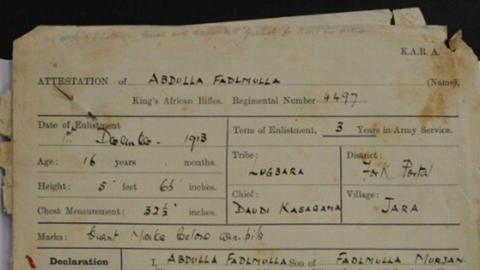
Research has unearthed thousands of old military documents
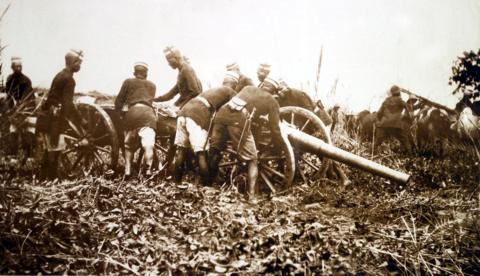
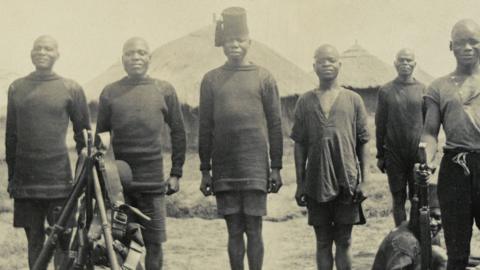
Soldiers in the King's African Rifles, pictured here in 1914, fought in battlefields across the world

The organisation also wants the records to help inform Kenya's school curriculum, so that new generations come to understand the outsized, yet overlooked role Africans played in the world wars.

"The only way any of this matters is that it isn't coming from people like me saying, 'This is your history'," CWGC's Mr Hay says.

"It's about people saying, 'This is our history' - and using the materials that we're working with."

The CWGC will continue recovering the details of Kenyan individuals who served in the British forces until every fallen soldier is commemorated.

"There is no end date... I mean this could go on for 1,000 years," Mr Abungu says.

"The process that is taking place is ensuring that those thousands of people who went away and never came back... we keep their memories going so that we don't forget them."