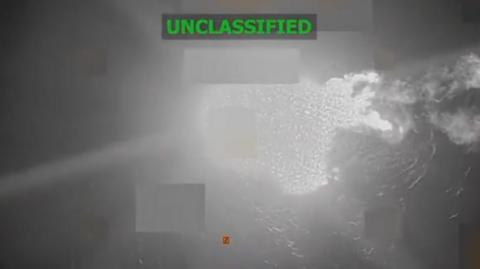
Colombian President Gustavo Petro has previously described the attacks as "murder" and said they were being used by the US to "dominate" Latin America.
Meanwhile, Venezuela's Nicolas Maduro accused Washington of "fabricating a war".
The two left-wing leaders have increasingly been at odds with the Trump administration.
Following Petro's comments, the US placed sanctions on him and his inner circle, as well as removing Colombia's certification as an ally in the war on drugs. Trump has threatened military action against land targets in Venezuela.
But this, he has admitted, may require the consent of the US Congress.
However, some US lawmakers, both Democrat and Republican, have said the strikes on vessels also required congressional approval - something Trump has denied.
Others have questioned whether the lethal strikes were legal at all.
The UN's human rights chief Volker Turk said on Friday that such attacks were a violation of international human rights law.
"Over 60 people have reportedly been killed in a continuing series of attacks carried out by US armed forces... in circumstances that find no justification in international law," he said.
"These attacks – and their mounting human cost – are unacceptable."
Experts in Latin American politics have suggested the strikes in the Caribbean and Pacific were part of a suite of measures designed to influence change in Colombia and Venezuela.
The US is among many nations that consider Maduro's election last year as illegitimate, while Trump has been critical of Petro's policies on combatting the drug trade in his country, which has traditionally been a US ally.
Washington has steadily been building up a force of warships, fighter jets, marines, spy planes, bombers and drones in the Caribbean over the past few months, which it has framed as part of a crackdown on drug-trafficking but which military analysts say is much larger than what is needed.