The prime minister said the Home Office was processing asylum claims "much more quickly" and removing those with no right to be in the country "at a higher rate than the best part of a decade".
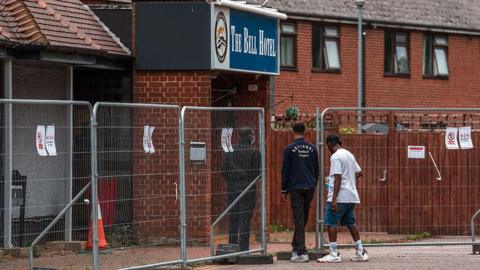
Just under 103,000 asylum seekers are being housed by the government, of which just over 32,000, around a third, are accommodated in 210 hotels.
Asylum accommodation is currently delivered through a series of large-scale, regional contracts agreed by the previous government with a number of private providers, which started in 2019 and will expire in 2029.
They allow for the use of "contingency accommodation" - usually hotels - when demand exceeds supply, but state that these should only be used on a short-term basis.
The report said the current system for housing people seeking asylum - with its reliance on hotels - was expensive, unpopular with local communities and unsuitable for the asylum seekers themselves.
The report said the contracts drawn up for accommodation providers under the Conservatives had been flawed and that "inadequate oversight" had meant failings went "unnoticed and unaddressed".
Expected costs for hotel contracts from 2019-2029 have risen from £4.5bn to £15.3bn, while two accommodation providers still owe millions in excess profits that the Home Office has not recovered, the report found.
The report said the department neglected its day-to-day management of the contracts, and had not sufficiently ordered financial penalties for providers who have poor performance.
This includes no fines for failures at hotels and the larger accommodation sites, while excess profits from providers are yet to be reclaimed.
The committee said the money should be used on public services, "not sitting in the bank accounts of private businesses".
There are few issues more sensitive for this government than its management of the asylum system.
While ministers have set a deadline for ending the use of asylum hotels by the next general election, most likely 2029, they want to show progress in reducing the numbers long before then.
Labour officials are especially anxious about how hotels can become a rallying point for frustration in different communities across the country.
The specific criticism of the Home Office is also the latest reminder of how many government controversies emanate from that department, following rows only in the last week over the grooming gangs inquiry, the collapse of the prosecution of two men accused of spying for China, and the return of a migrant deported to France under the 'one in one out' scheme.