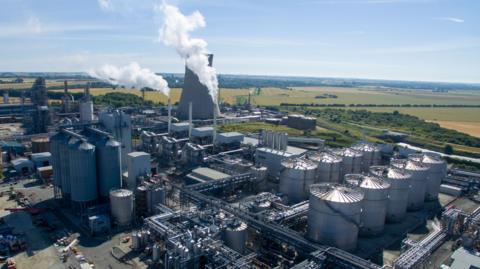
The project at Saltend would have given the UK a strategic foothold in the rare earths industry, which is currently dominated by China.
The magnets produced by the plant would have been used in high-tech applications such as motors for electric vehicles, wind turbines and robotics.
However, as first reported by Sky News, the plan has now been dropped.
Despite what the name implies, rare earths are actually relatively common. The term is used to describe a group of chemically similar minerals which are abundant in the Earth's crust – but which are also comparatively difficult and costly to extract.
However, according to Pensana, China has used its market power in recent years to keep prices artificially low in order to stifle potential competition, meaning it needs government support to make a project viable.
Speaking to reporters on Thursday at a meeting of the International Monetary Fund, Chancellor Rachel Reeves was asked about growing tension between the US and China over rare earths.
The chancellor said she was working with G7 counterparts "on our own critical minerals strategy, so that we are less reliant".
In 2022, Boris Johnson announced plans for "a multi-million pound investment" in the Saltend project - launched alongside the then Tory government's 'Critical Minerals Strategy'.
However, according to Pensana's founder and chairman, Paul Atherley, this contribution – actually £5m - was "nowhere near enough", and the Treasury proved unwilling to contribute more.
Mr Atherley compares this with a deal between the US government and MP Materials, under which MP will benefit from more than half a billion dollars worth of investment and soft loans to fund a similar facility in California, as well as a 10-year agreement to ensure all the magnets it produces are sold for a minimum price.
Earlier this year Pensana announced plans to team up with the US refiner ReElement, to develop a "sustainable, independent rare earth supply chain". It is also planning to list its shares on the Nasdaq stock exchange.
Mr Atherley insists he remains "very positive on the UK". Another company he is involved in, Tees Valley Lithium, is pushing ahead with plans for a lithium refinery in the Northeast.
A spokesperson for the Department for Business and Trade said: "It is disappointing Pensana has decided not to proceed with this development, but it is ultimately a commercial decision for the company.
"We will publish a new Critical Minerals Strategy soon to help secure our supply chains for the long term, and we're reducing industrial electricity costs for businesses as part of our modern Industrial Strategy."