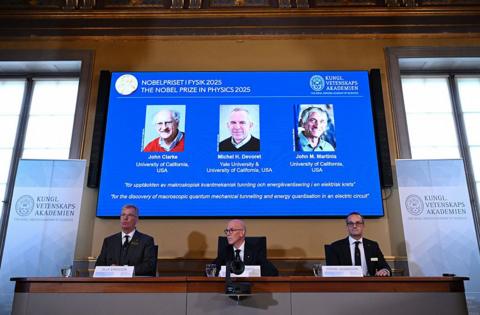
But its implications have been profound and far-reaching. The electronic devices that most of us use rely on it, and the findings are being used to build extremely powerful computers.
"This is something that leads to development of the quantum computer. Many people are working on quantum computing, our discovery is in many ways the basis of this," said Prof Clarke on the phone to the news conference moments after he was told he had won.
He appeared mystified that his work completed forty years ago is worthy of science's most prestigious prize.
"I'm completely stunned. At the time we did not realise in any way that this might be the basis for a Nobel prize," he said.
Quantum mechanics relates to the behaviour of tiny things in a tiny world. It refers to what particles like the electron do in the sub-atomic world.
Professor Clarke and his team looked at how these particles appeared to break rules like travelling through energy barriers that conventional physics said was impossible - something called "tunnelling".
Using quantum "tunnelling", the electron manages to burrow through the energy barrier.
Their work demonstrated that tunnelling can be reproduced not only in the quantum world, but also in electrical circuits in the 'real world'.
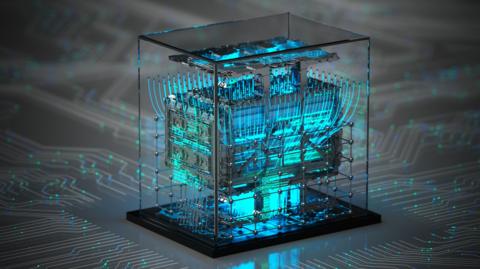
This knowledge has been harnessed by scientists in making modern quantum chips.
"This is wonderful news indeed, and very well deserved," said Professor Lesley Cohen, Associate Provost in the Department of Physics at Imperial College London.
"Their work has laid the foundations for superconducting Qubits - one of the main hardware technologies for quantum technologies."