Wubi News

Dame Jane Goodall revolutionised our understanding of our closest primate cousins

2025-10-02 06:00:09

She was a serene force of nature. And she never wavered in her mission to help the animals to which she dedicated her life.

When I interviewed Dame Jane Goodall last year, she exuded calm, even as she pressed home to me that a great extinction crisis was facing our planet.

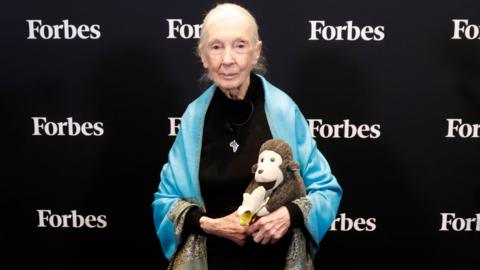
Over a slightly blurry video call, I could see her toy monkey, Mr H, behind her.

That toy was given to her nearly 30 years ago by a friend. Dr Goodall, who was 90 years old when we spoke, was still travelling the world with Mr H at her side.

Researchers I've spoken to this evening, whose work Dr Goodall inspired, or who were simply inspired by her energy, are in shock at her death aged 91.

Professor Cat Hobaiter, from the University of St Andrews, who has worked with Chimpanzees - studying their communication - for more than 15 years, told me that one reason Dr Goodall had such an impact was that "she gave up doing what she loved - spending time with her beloved chimpanzees - to tirelessly travel the world and share her passion with everyone she met."

In the many years that Jane Goodall observed and studied chimpanzees, she revolutionised our understanding of our closest primate cousins.

Key to her groundbreaking discoveries were her curiosity and ability - quietly - to observe.
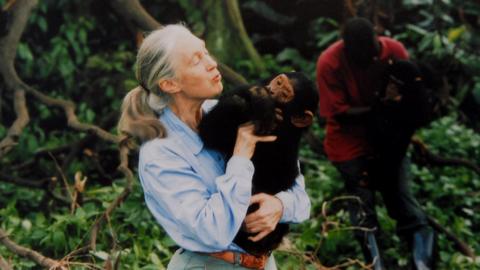
Dr Goodall "gave up doing what she loved... to tirelessly travel the world and share her passion"

It was during her time in the rainforest reserve at Gombe, in Tanzania, when she stopped to spend time watching a male chimpanzee who was foraging.

The chimp took a twig, bent and stripped it of its leaves, then he poked it into a termite's nest. He then used that stripped, bent twig to spoon the termites into his mouth.

That observation - in 1960 - challenged the belief that only humans made and used tools.

Even as she changed our understanding of the natural world, Dr Goodall faced cynicism and sexism. She was not formally trained as a scientist. And, in the 1960s, that was unusual.

Her work in Gombe went on to show that chimps also form strong family bonds - and even that they engage in warfare over territory.

But her approach – associating so closely with the animals she studied, naming them and even referring to them as "my friends" - made her unpopular with the male-dominated scientific establishment.

Her supervisor and mentor, Professor Louis Leakey, saw the value in that informality.

"He wanted somebody whose mind wasn't messed up by the reductionist attitude of science to animals," she said.

Dr Goodall was still travelling the world into her 90s with her toy monkey, Mr H, at her side