Wubi News

David Bowie’s secret final project discovered locked in his study

2025-09-05 08:00:12
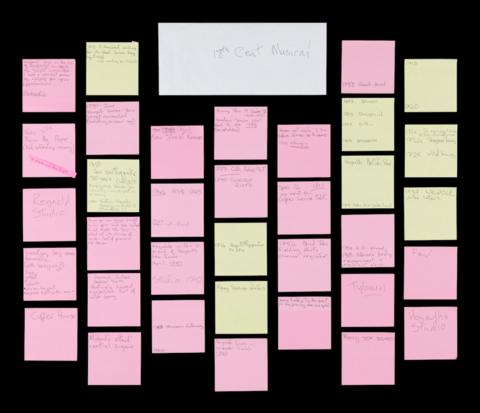
Bowie made dozens of sticky notes with ideas for his musical, which could be moved around to create a structure

Bowie's notes for The Spectator were found as he had left them, pinned to the walls and stored in his office in New York.

The room was always locked – only Bowie and his personal assistant had a key – so they were left undisturbed until archivists started cataloguing his belongings.

They will be available for fans and scholars to view when the David Bowie Centre opens at the V&A East Storehouse in Hackney Wick on 13 September.

"We even have the desk [where he worked] at the Storehouse, as well," says Madeleine Haddon, the collection's lead curator.
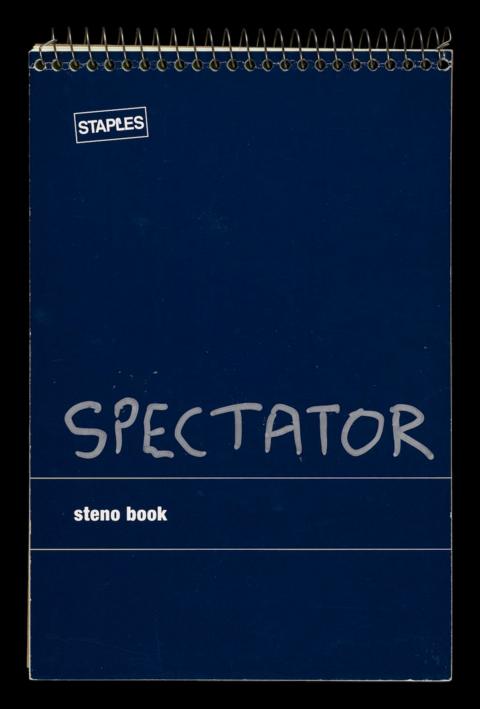
The musician's handwritten notes have been made available for the public to study, along with 90,000 other artefacts, at the V&A Museum's East Storehouse in London

An entire notebook is devoted to The Spectator, a daily periodical that ran for 555 issues between 1711 and 1712 commenting on the manners and fads of London society.

Writing in black pen, Bowie summarised several of the publication's key essays, scoring them out of 10.

He particularly enjoyed a morality tale about two sisters – one beautiful but "vain and severe", who lost a suitor to her plain, but more agreeable, sibling.

Awarding it eight out of 10, Bowie commented, "could be a good subplot".

He was also amused by a report concerning a Mr Clinch of Barnet, who could imitate the sounds of horses, hounds, an old woman and a bassoon "all with his own natural voice, to the greatest perfection".

Prof Bob Harris, a historian and 18th Century specialist at the University of Oxford, says he can understand why the period caught Bowie's attention.

"London, at that stage, was such an exciting, vibrant and diverse city," he says.

"It was the largest city in western Europe, with a population of over half a million, and it had an ebullient print media that was constantly commentating on the fashions and follies of the age."

Bowie was particularly fascinated by crime and punishment.

In one note, he envisaged the aftermath of a public hanging, with "surgeons fighting over corpses".

He also considered making Jack Sheppard, a petty thief who had won the public's affection, one of the main characters. He also references "thief-taker general" Jonathan Wild, a vigilante who was responsible for Sheppard's arrest and execution.

Another possible plot point involved a "central figure" in the musical being attacked by a notorious gang known as the Mohocks.

"The Mohock phenomenon emerged in 1712 and became a media frenzy," says Prof Harris.

"And what it involved was young men of high social status basically getting drunk in the evening and then attacking people on the streets of London, often women, sometimes elderly Watchmen.

"London threw up so many different juxtapositions. Juxtapositions between high and low, between the virtuous and the criminal, and these things existed cheek by jowl.

"I think it presented so much that was beguiling to contemporaries, but also clearly that Bowie himself found fascinating."

Bowie wrote several songs about London – including I Dig Everything and The London Boys – but they were all based on contemporary observations, making The Spectator something of a departure

On a broader level, Bowie constructed a chronology of the early 18th Century, looking at painters such as Joshua Reynolds and William Hogarth, and the creation of the Royal Academy.

"He was interested in the development of musicals themselves in London in this period, and how musicals were used for political satire, particularly towards the Robert Walpole government," says Haddon.

"It seems he was thinking, 'What is the role of artists within this period? How are artists creating a kind of satirical commentary?'"

She speculates that the musician was drawing parallels between the Enlightenment and the modern day.

"It's interesting to think that Bowie was working on this in the US in 2015, with the political situation that was taking place there. Was he thinking about that: The power of art forms to create change within our own political moment?" she asks.

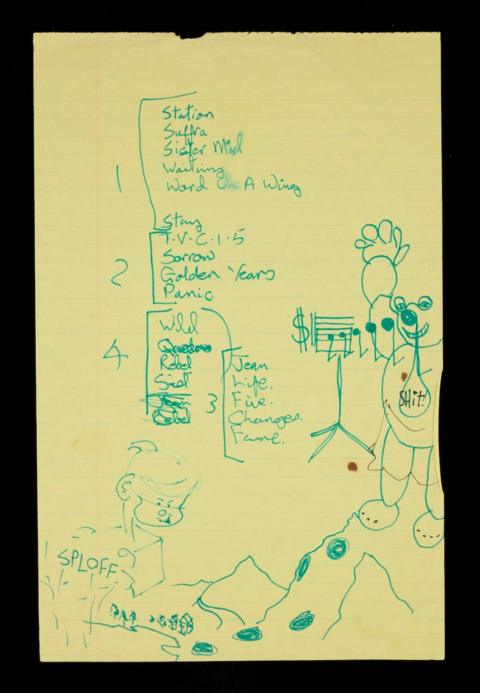
The Bowie Collection will also allow fans to view items like this handwritten setlist for the tour supporting Bowie's 1976 album Station To Station