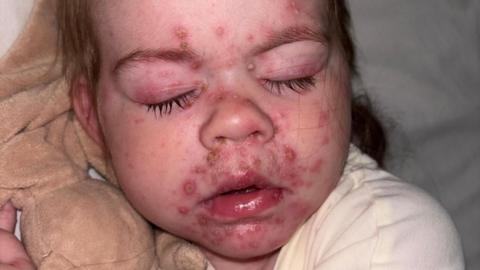
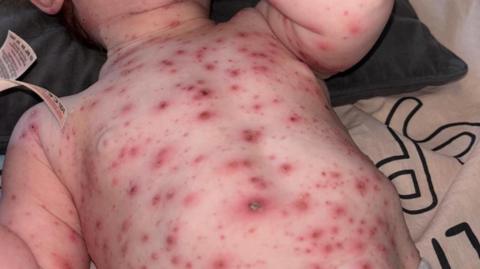
Chickenpox is generally mild but can be very severe for some people. Pregnant women are particularly at risk as it can cause complications for both the mother and her baby.
Very young infants and adults are also more likely to experience serious illness compared to children.
In rare cases it can cause a swelling of the brain, called encephalitis, an inflammation of the lungs, called pneumonitis, and stroke, which can result in hospitalisation and, in very rare cases, death.
The Joint Committee on Vaccination and Immunisation (JCVI), which advises UK health departments, recommended the introduction of the vaccine on the NHS in November 2023.
Experts say vaccination will dramatically reduce the number of chickenpox cases overall, leading to far fewer of the more serious ones.
Dr Gayatri Amirthalingam, deputy director of immunisation at the UK Health Security Agency (UKHSA), said vaccination could be "a life saver" for some.
Prof Adam Finn, a paediatrician who was a member of the JCVI, said chickenpox is a "rotten illness" that is often thought of as "trivial".
The vaccine means chickenpox "is going to be a thing of the past in the near future", he said.
The UK has lagged behind other countries in offering the jab, Prof Finn said, including the US, where it was introduced first in the 1990s.
He said the main reason for this was because chickenpox "lurks around in your body for the rest of your life" and can later come back as varicella zoster virus (VZV) or shingles. Health experts feared that if chickenpox stopped circulating, "people wouldn't be re-exposed to the virus, their immunity would wane away and we would see more shingles".
"Finally, we've now realised that concern is much, much smaller - it's almost non-existent," he added.