Wubi News

Thirsty data centres boom in drought-hit Mexico

2025-08-29 08:00:08
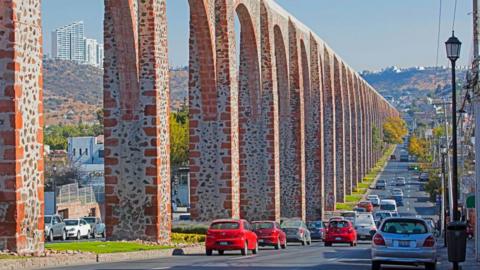
Querétaro is known for its impressive stone aqueduct

Located in the middle of Mexico, Querétaro is a charming and colourful colonial-style city known for its dazzling stone aqueduct.

But the city, and state of the same name, is also recognised for a very different reason - as Mexico's data centre capital.

Across the state companies including Microsoft, Amazon Web Services and ODATA own these warehouse-like buildings, full of computer servers.

No one could supply an exact number, but there are scores of them, with more being built.

Ascenty, which claims to be the largest data centre company in Latin America, has two in Querétaro, both around 20,000 sq ft in size, with a third under construction.

It is forecast that more than $10bn (£7.4bn) in data centre-related investment will pour into the state in the next decade.

"The demand for AI is accelerating the construction of data centres at an unprecedented speed," says Shaolei Ren, associate professor of electrical and computer engineering at the University of California Riverside.

So, what's the attraction of Querétaro?

"It's a very strategic region," explains Arturo Bravo, Mexico country manager at Ascenty.

"Querétaro is right in the middle [of the country], connecting east, west, north and south," he says.

That means it is relatively close to Mexico City. It is also connected to high-speed data cables, so large amounts of data can be shifted quickly.

Mr Bravo also points out that there is support from the municipality and central government.

"It's been identified as a technology hub," he says. "Both provide a lot of good alternatives in terms of permits, regulation and zoning."

But why are many US companies choosing this state over somewhere closer to home?

"The power grid capacity constraint in the US is pushing tech companies to find available power anywhere they can," says Shaolei Ren, associate professor of electrical and computer engineering at the University of California Riverside, adding that the cost of land and energy, and business-friendly policies are also attractive.

Shaolei Ren says US tech firms are searching for electricity availability

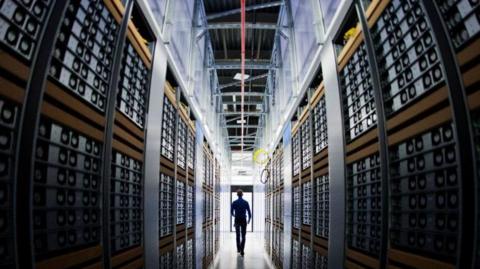
Data centres host thousands of servers - a specialised type of computer for processing and sending data.

Anyone that's worked with a computer on their lap will know that they get uncomfortably hot. So to stop data centres melting down, elaborate cooling systems are needed which can use huge amounts of water.

Data centres house thousands of servers which need constant cooling
Teresa Roldán says local authorities are putting the water needs of industry first

Another concern for those living near data centres is air pollution.

Prof Ren says data centres typically rely on diesel backup generators that release large amounts of harmful pollutants.

"The danger of diesel pollutants from data centres has been well recognised," he says, pointing to a health assessment of the air quality surrounding local data centres by the Department of Ecology at the state of Washington.

Mr Bravo responded to those concerns by saying: "We operate under the terms and conditions specified by authorities, which, in turn, in my perspective, are the ones taking care of the fact that those conditions are acceptable for the communities around and the health of everybody."

As for the future, Ascenty is planning more data centres in the region.

"I do see it just kind of progressing and progressing, with a new data centre there every few years," says Mr Bravo.

"The industry will continue to grow as AI grows. It's a great future in terms of what is coming."