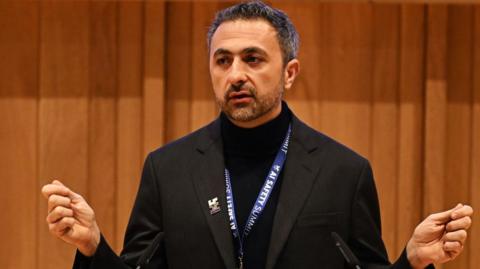
There are increasing reports of people suffering "AI psychosis", Microsoft's head of artificial intelligence (AI), Mustafa Suleyman, has warned.
In a series of posts on X, he wrote that "seemingly conscious AI" – AI tools which give the appearance of being sentient – are keeping him "awake at night" and said they have societal impact even though the technology is not conscious in any human definition of the term.
"There's zero evidence of AI consciousness today. But if people just perceive it as conscious, they will believe that perception as reality," he wrote.
Related to this is the rise of a new condition called "AI psychosis": a non-clinical term describing incidents where people increasingly rely on AI chatbots such as ChatGPT, Claude and Grok and then become convinced that something imaginary has become real.
Examples include believing to have unlocked a secret aspect of the tool, or forming a romantic relationship with it, or coming to the conclusion that they have god-like superpowers.