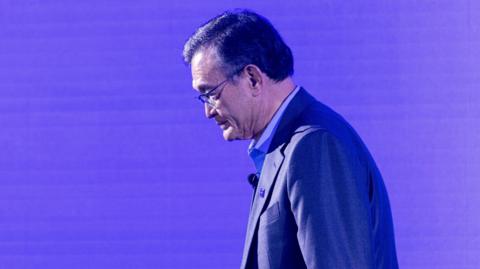
In a statement on Thursday, Intel said it was making significant investments in the US aligned with Trump's "America First agenda".
"Intel, the board of directors and Lip-Bu Tan are deeply committed to advancing US national and economic security interests," it said, adding: "We look forward to our continued engagement with the administration."
A naturalised US citizen born in Malaysia and raised in Singapore, Mr Tan is a venture capitalist well-known for his expertise in the semiconductor industry.
In a recent update to investors, he said the firm would be scaling back its investments in manufacturing, including in the US, to match demand from customers.
Intel has already cut thousands of jobs this year as part of an effort to "right-size" the firm.
Shares in Intel fell more than 3% by midday after the attack from Trump, who has been critical of the firm previously and is preparing to raise tariffs on the chip industry.
"The CEO of INTEL is highly CONFLICTED and must resign, immediately. There is no other solution to this problem," Trump wrote.
It is not illegal for Americans to invest in Chinese firms.
But Washington has ramped up restrictions since Trump's first term, as it pushes to break business ties between the US and China when it comes to advanced technology, as both Democrats and Republicans openly worry about national security.
Trump's attack took up concerns aired by Republican Senator Tom Cotton this week in a letter to Intel's board that said Mr Tan's "associations raise questions about Intel's ability" to be a "responsible steward of American taxpayer dollars and to comply with applicable security regulations".
Cotton pointed to Mr Tan's role as the longtime chief executive of tech firm Cadence Design Systems, which pleaded guilty in July and agreed to pay $140m over US charges that its subsidiary in China had repeatedly done business with the country's National University of Defense Technology, violating US export controls.
Mr Tan himself was not indicted.
In a statement earlier this week, Intel defended its relatively new chief executive, saying Mr Tan and the company were "deeply committed to the national security of the US and the integrity of our role in the US defense ecosystem".